

Not sure what to do with your life in the modern, dynamic German job market? The job market research provides an excellent understanding of the expanding industries, the skills required, compensation, and employment opportunities across Germany, enabling informed and confident career choices.
Through career trends analysis in job opportunities, skills, and industry development in Germany, you will be able to find high-potential careers, what employers seek, and how to succeed in the long term.
This guide explains it all about job market research, including the reasons why it matters, how it is done, and the ability to utilize it to select an optimal career, upgrade successfully, earn higher salaries, and achieve a successful future.
What Is Job Market Research?
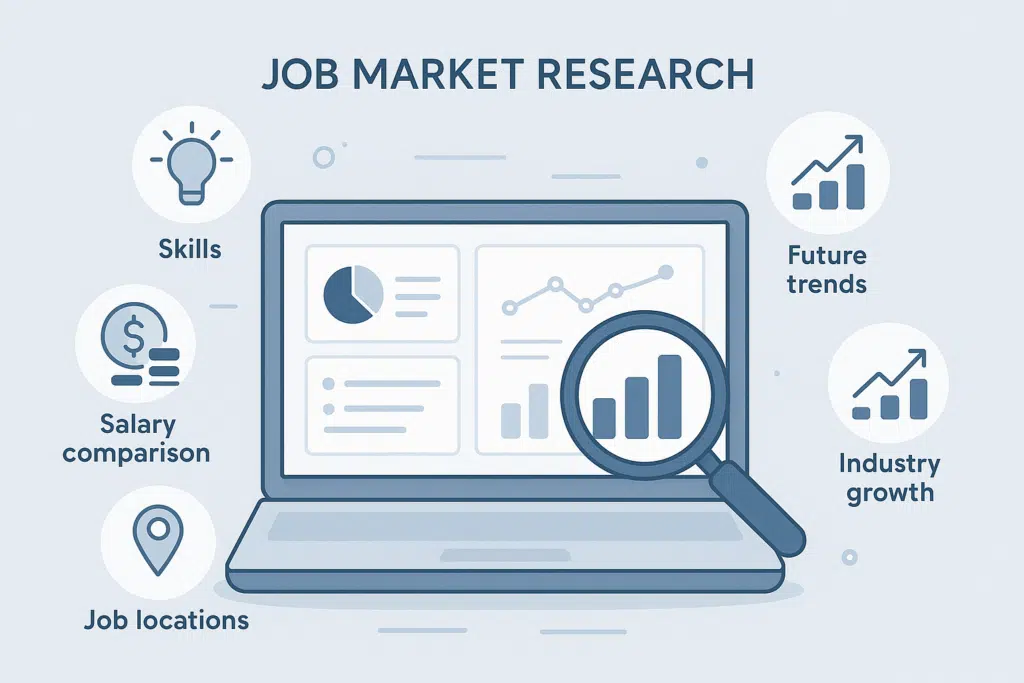
Job market research refers to the acquisition and study of employment data on employment trends, skills demanded, pay scales, job opportunities, industry expansion, and career prospects, within a specific country, such as Germany. It assists you in knowing what the job market requires at the moment.
It deals with various subjects, which include:
- What are the booming and fatiguing industries?
- The most sought-after skills by employers.
- The comparison of salaries across German cities and regions.
- The competitive position of some careers.
- Which of the geographical locations in Germany is the most job-rich?
- What are the credentials that are becoming urgent in the German labor market?
- What are the technological changes that are changing the workplace?
Job market research gives one a true picture of what is going on in the labor market and allows them to make wise decisions as opposed to making educated guesses.
Types of Job Market Research
1. Qualitative Research
Involves interviews, networking, information meetings, and talking to people working in the industry.
2. Quantitative Research
Categories include job numbers, wages, employment rates, skills development, and economic figures.
3. Primary Research
You have to amass the data by yourself via surveys, interviews, or outreach.
4. Secondary Research
This includes reports from German labor authorities, federal statistics, industry associations, and economic research institutes.
How to Conduct Job Market Research
The following is a step-by-step process that is very practical and easy to follow by the users.
Step 1: Clarify Your Career Goals
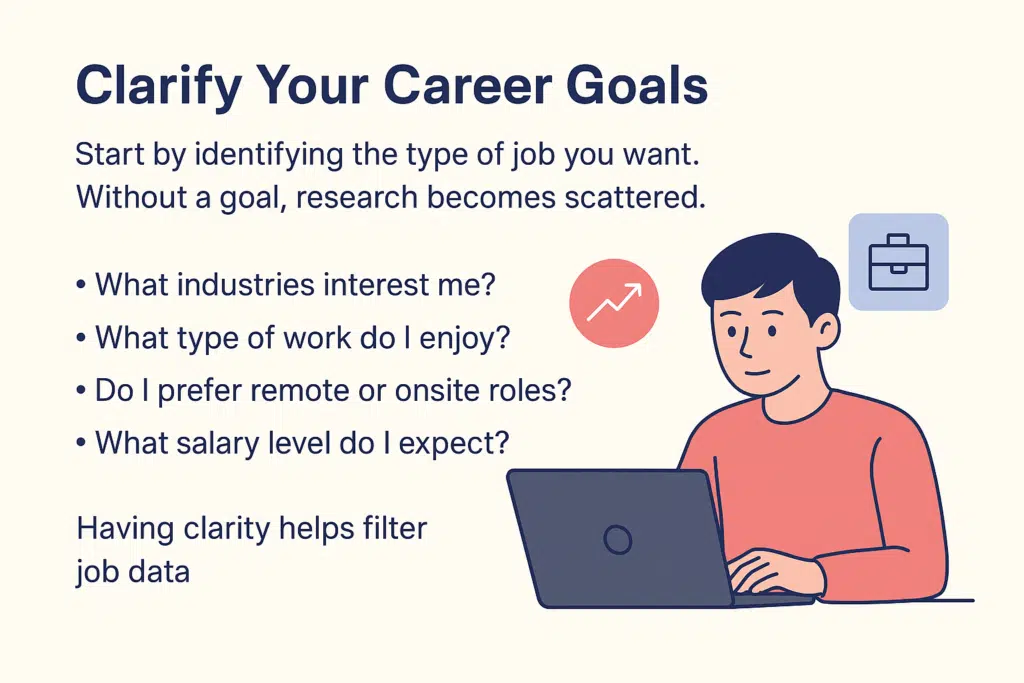
Begin by finding the kind of employment you desire. In the absence of a purpose, the study is disjointed.
Ask yourself:
- What industries interest me?
- What type of work do I enjoy?
- Which do I like: remote or onsite jobs?
- What salary level do I expect?
Clarity assists in filtering job data.
Step 2: Study Industry Growth Trends
It is also important to look at the growth, stability, or decline of your target industry. Reliable sources of reports and job data. The growth trends show the future job security.
- Example:
- In Germany, fast-growing industries include engineering, automotive technology, IT, healthcare, renewable energy, AI, and manufacturing.

Read Also: Germany International Driving Licence: Apply Fast & Avoid Fines
Step 3: Analyze Job Postings for Required Skills
Many roles in Germany also emphasize formal qualifications and certifications.
Focus on:
- Skills
- Experience levels
- Tools and software
- Certifications
- Job responsibilities
List the most repeated skills -these are the core skills for your target career.
Step 4: Research Salary Ranges and Benefits
Salaries in Germany vary significantly by city, federal state, and industry, making localized salary research essential. You should check:
- Average salary
- Salary by experience
- Salary by city
- Benefits and perks
This will prevent low-pay job offers and keep in mind what to expect.
Step 5: Analyze Job Market Competition
This is due to the fact that the degree of competition determines the ease or difficulty of getting a job.
Evaluate:
- What number of applicants per job?
- Experience (entry-level, mid-level, senior) is required.
- Demand is high in relation to supply.
When there is a lot of competition, you might require more skills to come out.
Step 6: Examine Geographic Job Demand
The opportunities are different in location. Cities have more employment opportunities, and this is because of industries.
Check:
- Which cities hire the most
- The presence or absence of remote hiring.
- Regional disparities in salary.
This is especially important for professionals planning to work, relocate, or settle within Germany.
Step 7: Study Employer Expectations
Employers incorporate what they desire from an applicant. Employers in Germany often prioritize formal qualifications, relevant experience, technical accuracy, and reliability. The information is useful in positioning your resume and career preparation.
Examples include:
- Soft skills
- Technical competencies
- Working style
- Industry knowledge
Realizing the expectations increases the success of job applications.
Step 8: Track Emerging Technologies and Future Skills
The workplace is undergoing a continuous transformation because of technology. The recognition of skills that will be required in the future sets you ahead of others.
Examples:
- AI tools
- Blockchain
- Automation systems
- Cloud platforms
- Data analytics
This is because this will secure stability in a career in the long run.
Step 9: Turn Insights Into a Career Action Plan
A plan may include:
- Which skills to learn
- Which certifications are to be undertaken?
- Which roles to target
- Which industries to focus on
- Salary goals
- Timeline for improvement
A career plan enhances your probability of career success.
Key Job Market Indicators You Should Analyze
When you know the underlying indicators, job market research in the German labor market is stronger.
1. Employment Rate
Shows overall job health.
2. Industry Growth Rate
Shows whether the number of job opportunities is on the increase.
3. Salary Growth Trends
Discloses whether incomes in your discipline are increasing or not.
4. Job Vacancy Rate
Demonstrates the challenge of employers filling jobs.
5. Skill Gap Trends
Shows areas of weakness that are highly sought after – high opportunities.
6. Remote Work Demand
Critical in the case of flexible seekers or international seekers.
7. Education and Certification Requirements
Demonstrates what is most important in a qualification.
Common Mistakes to Avoid in Job Market Research
Job market research is done in the wrong way by many people. Avoid these mistakes:
- The use of a single job posting site.
- Disregard the future trends and take care of the current demand.
- Failure to review salary differentials by location.
- Overlooking required certifications.
- Not analyzing competition.
- Ignoring qualification recognition or local certification requirements in Germany.
- Using outdated information.
- Disregarding soft skills employment requirements.
These mistakes can be learned from to make more precise career choices.
How to Use Job Market Research for Career Success
Information about the job market can only be helpful when used appropriately.
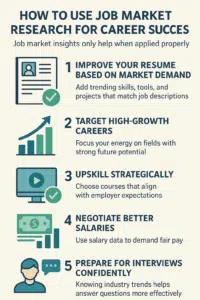
1. Improve Your Resume Based on Market Demand
Add trending skills, tools, and projects that match job descriptions.
2. Target High-Growth Careers
Focus on the areas that are promising in the future.
3. Upskill Strategically
Choose the courses to the satisfaction of the employer.
4. Negotiate Better Salaries
Negotiate good salaries using salary information.
5. Prepare for Interviews Confidently
The knowledge of the trends in the industry is used to provide answers to questions in a more meaningful way.
Frequently Asked Questions (FAQs)
1. What is job market research?
It will be the process of gathering and evaluating information on career trends, wages, skills, and employment demand.
2. Why is job research in the job market valuable?
It assists individuals in making the correct career path, knowledge of wages, and how to do in advance job trends.
3. What is my method of carrying out job market research?
Study job postings, analyze industry reports, compare salaries, and check skill trends.
4. Will job market research assist me in securing a job?
Yes. It shows what the employers want and gets you in a better place.
5. What are the tools I have to work with to do job market research?
The good ones are LinkedIn, Indeed, Glassdoor, Payscale, BLS, and Google Trends.
6. How does job market research work in Germany?
Job market research in Germany involves analyzing local job demand, salary differences by region, required qualifications, and industry growth trends to make informed career decisions.
Read Also: 9 Best Cities in Spain for Expats
Final Words
Job market research is among the most useful tools for analyzing a successful career in Germany. It shows the growth in industries, skills needed, wage rates, and opportunities that will be valuable after following. As a job seeker, a student, or a working professional, one can always be prudent to be informed about the job market so that one can make smart and confident decisions in their decisions within the German job market. With this information in hand, you will be able to choose the best jobs, train the best skills, bargain for better pay, and have a long-term career.