
Have you finally reached the end of your professional life and cannot even guess how? Portugal is one of the best retirement places in Europe, which has a favourable climate, culture, and quality of life. Getting a Retirement Visa (D7 Visa) is the first step that is required in order to make your dream move a reality.
In this guide, I will take you through the whole process- requirements on eligibility up to application processes so that you can easily and comfortably retire in Portugal.
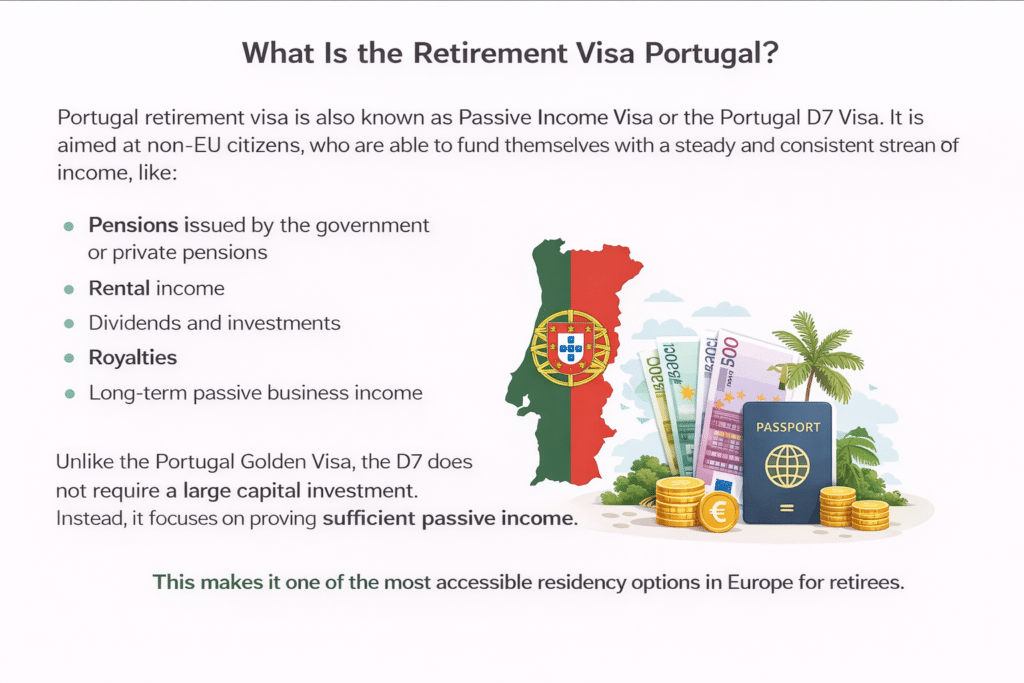
What Is the Retirement Visa Portugal?
The Portuguese retirement visa is also referred to as the Passive Income Visa or thePortugal D7 Visa. It targeted non-EU citizens who have access to a consistent and regular flow of income, including:
- The government or the private pensions issue pensions.
- Rental income
- Dividends and investments
- Royalties
- Long-term passive business income
The D7 does not need alarge capital investment as compared to the Portugal Golden Visa. Rather, it aims at demonstrating adequate passive income.
Who Is Eligible for the Portugal Retirement Visa?
To obtain the Portugal D7 Visa, you will be required to:
- Be a non-EU/EEA/Swiss citizen
- Be at least 18 years old
- Have a clean criminal record
- Prove stable passive income
- Show proof of accommodation in Portugal
- Have valid health insurance
- Be willing to reside in Portugal
No age restriction is imposed; hence, this is best suited to the retirees.
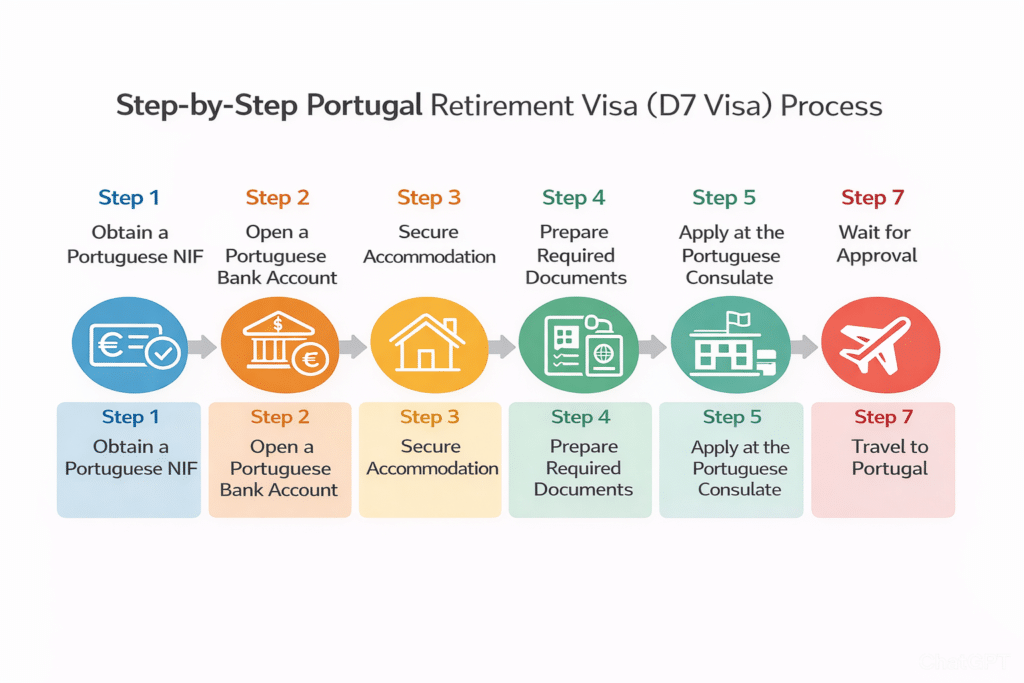
Step-by-Step Portugal Retirement Visa (D7 Visa) Process
The Portugal D7 Visa or the Portugal Retirement Visa is a visa that enables non-EU citizens with stable passive income to legally live in Portugal.
Step 1: Obtain a Portuguese NIF
The NIF (Número de Identificação Fiscal) is your Portuguese tax number.
You need it to:
- Open a bank account
- Sign a rental contract
- Buy property
- Conduct financial transactions
You can get it either in a tax office or from a representative of the law.
Step 2: Open a Portuguese Bank Account
Using your NIF, open a Portuguese bank account and deposit enough money, which is typically a year (or more) of estimated income.
Approximate examples:
- Single applicant: €11,000+
- Couple: €16,000+
- Additional child: extra required amount
Carrying money within Portugal makes your D7 visa application stronger.
Step 3: Secure Accommodation
You will have to demonstrate that you have accommodation in Portugal. Acceptable options include:
- Long-term rental agreement (6–12 months)
- Property purchase
This authenticates your desire to be living in Portugal which is one of the major D7 requirements.
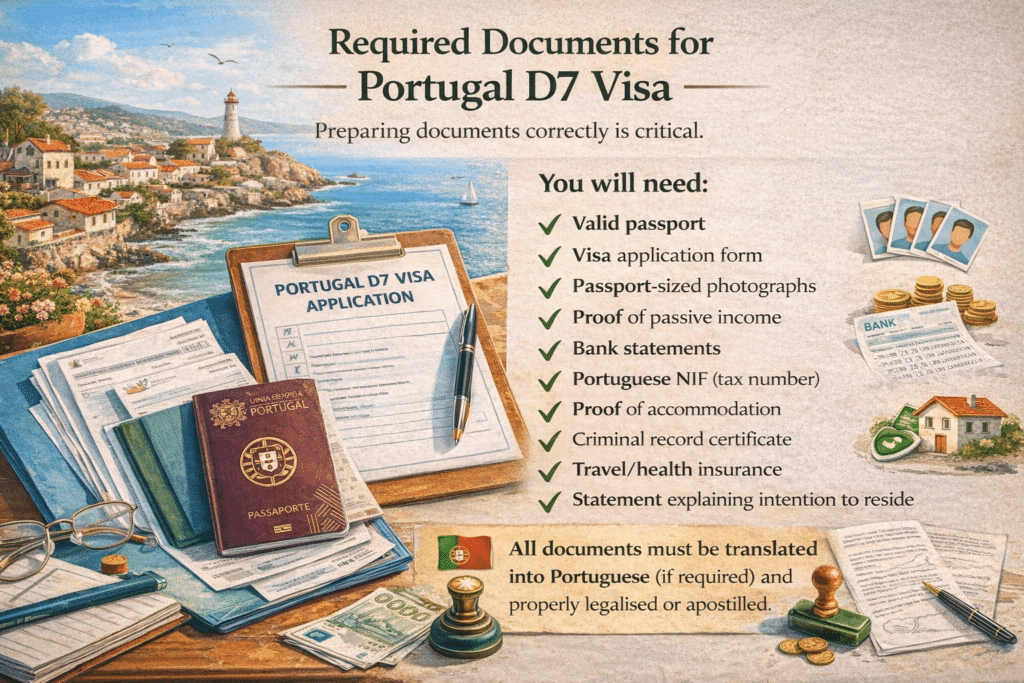
Step 4: Prepare Required Documents
You will need:
- Valid passport
- Visa application form
- Passport photos
- Proof of passive income
- Bank statements
- NIF and Portuguese bank proof
- Rental contract or property deed
- Criminal record certificate (apostilled)
- Health insurance
- Cover letter
Documents may require translation and apostille certification.
Step 5: Apply at the Portuguese Consulate
Submit your application in your country of residence.
At your appointment:
- Submit documents
- Provide biometrics
- Pay the visa fee
- Attend a short interview
Step 6: Wait for Approval
The processing time is normally 2-4 months. You are given 4 month entry visa (two entries), being approved.
Step 7: Travel to Portugal
After obtaining your D7 entry visa, you have to visit Portugal. You will complete your residency status in Portugal.
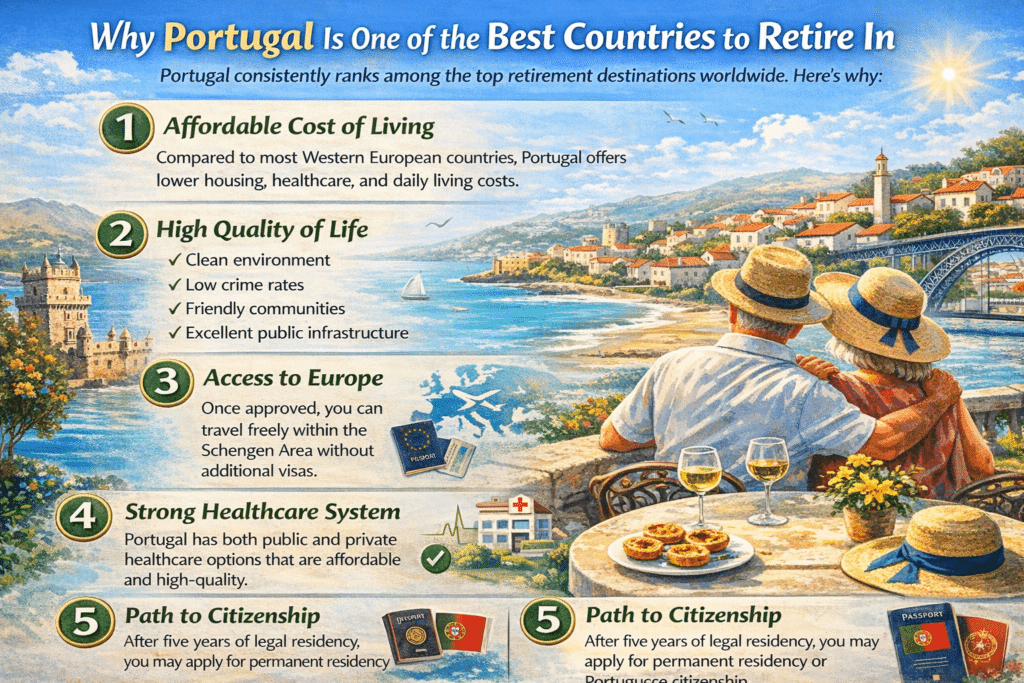
Why Portugal Is One of the Best Countries to Retire In
Portugal is always one of the first choices of the best retirement destinations in the world. Here’s why:
1. Affordable Cost of Living
Portugal has less expensive living, healthcare, and housing costs as compared to most of the countries in Western Europe.
2. High Quality of Life
Portugal offers:
- Clean environment
- Low crime rates
- Friendly communities
- Excellent public infrastructure
3. Access to Europe
Once approved, there is no need to have any extra visa to move around the Schengen Area.
4. Strong Healthcare System
Portugal possesses affordable and quality healthcare in terms of both public and private.
5. Path to Citizenship
Five years after living in the country legally, you can request permanent residency or Portuguese citizenship.
Read Also: Immigration vs Emigration Explained for Expats (2026)
Portugal Retirement Visa Income Requirements
One of the most important ranking factors for this topic is clarity around financial thresholds. All the papers will have to be translated into Portuguese (where necessary) and legalized or apostilled.
Minimum Required Passive Income
As of 2026:
- Main applicant: approx. €920 per month
- Annually: approx. €11,040
For family members:
- +50% for spouse
- +30% per dependent child
Example Breakdown
| Family Type | Annual Income Required |
|---|---|
| Single Applicant | €11,040 |
| Applicant + Spouse | €16,560 |
| Couple + 1 Child | €19,872 |
Proof of Savings
In addition to passive income, applicants often need to show one year’s income saved in a Portuguese bank account.
Opening a Portuguese bank account before applying significantly strengthens your case.
Processing Time
- The visa normally requires 2-4 months at the consulate.
- Upon arrival, it may take you a couple of weeks to be issued your residence card.
- Waiting time varies according to your country and the amount of work at consulates at that time.
Residency Requirements
To maintain your D7 visa:
- Reside not less than 6 months in a year, continuously in Portugal, or
- Stay 8 non-consecutive months annually.
Failure to do this may impact on your visa renewal or ability to become a citizen later.
Benefits of the Portugal Retirement Visa
- Legal Residency: You are allowed to legally stay in Portugal.
- Schengen Travel: Travel freely to the bulk of Europe without any extra visas.
- Access to healthcare: Accessible to both state and non-state healthcare.
- Family Reunification: Spouse, dependent children.
- Citizenship: You can obtain Portuguese citizenship after 5 years of residence (you also need to comply with language criteria).
Cost of Living in Portugal for Retirees
Portugal is cheap as compared to a number of European nations. The approximate monthly analysis is as follows:
| Item | Cost |
|---|---|
| Rent (1-bedroom, outside city center) | €600–€900 |
| Utilities | €100–€150 |
| Groceries | €250–€400 |
| Private health insurance | €40–€100 |
| Dining & leisure | €150–€300 |
On the mainland, beyond Lisbon, a couple can comfortably afford approximately EUR 1,800-EUR 2,500 a month.
Best Places to Retire in Portugal
- Lisbon: Capital city; lively and cultural, but more expensive.
- Porto: A smaller city that is rather charming, affordable, and cultural.
- Algarve: Hot and very attractive to retirees.
- Silver Coast: Low cost of living in the coastal region that is growing with a large expatriate population.
Frequently Asked Questions (FAQs):
What is the Portugal Retirement Visa (D7 Visa)?
The D7 Visa or Passive Income Visa is a visa that gives a non-EU citizen a chance to retire in Portugal with the condition that he or she has a fixed passive income, either in the form of a pension.
Who qualifies as a Retirement Visa applicant to Portugal?
To be eligible by Portugal D7 Visa, one should:
- Over 18 years old
- A non-EU/EEA/Swiss citizen
- Has sufficient passive income
- Can provide proof of accommodation
- Well insured in good health, and with a clean criminal record.
How much money is the minimum income needed to be one of the holders of the Portugal Retirement Visa?
As of 2026:
- Single applicant: ~€920 per month (€11,040 per year)
- Spouse: +50% of the main applicant’s income
- Child: +30% per child
The income may be in the form of pensions, investments, rental, or other passive sources.
Is my family eligible for my application of D7 Visa?
Yes! D7 Visa will enable you to include:
- Spouse
- Dependent children
- Dependent adult family members
Each family member will need extra income and evidence of accommodation.
Is it necessary to purchase property in Portugal under the D7 Visa?
No, there is no need to purchase property. There is no problem with renting, provided that you demonstrate stable accommodation in Portugal.
Read Also: French Citizenship for EU Citizens: Timeline & Process
Final Words
Retiring in Portugal does not just imply obtaining a visa and spending a lazy life enjoying the tropical beaches, exploring the old towns, and having access to excellent healthcare services in one of the safest and most hospitable places in Europe.
Portugal Retirement Visa (D7 Visa) opens the door to this dream. Certainly, with a stable passive income and proper planning, you are able to obtain legal residency and live anywhere in Europe.