

Expatriate retirement in Portugal is one of the life-changing models of retirement and has emerged as the best retirement destination in Europe, especially with its serene atmosphere, relative living standards, and extended program of permanence in the European Union. The Portugal Retirement Visa is one of the most convenient and most rewarding avenues to take in case you are planning to move to Europe after your retirement.
In this step-by-step guide to retiring in Portugal, you will find out what to apply for, visa application, income requirements, costs, benefits, and the most frequent errors to avoid, to ensure that you apply with confidence and are likely to be approved.
What Is the Portugal Retirement Visa?
The Portugal Retirement Visa is normally referred to as the Portugal D7 Visa. It is aimed at the non-EU retirees who can live on passive income, which may be any of the following: pensions, rent, dividends, or savings.
This visa allows retirees to:
- Live legally in Portugal
- Move across the borders of the Schengen Area without restriction.
- Request permanent residency or citizenship in five years.
The Portuguese retirement visa option is flexible, cheap, and user-friendly for expatriates compared to many of the European visas, and is thus the best option to settle permanently.
Who Can Retire in Portugal?
Portugal has no restrictions on retirees from non-EU and non ETA countries; they can work in their own country without depending on local jobs. Portugal Retirement Visa (D7 Visa) is the best visa to consider when one wants to spend long, relaxing days in Europe.
You may retire in Portugal since you:
- Do you intend to spend the long term in Portugal as a non-EU citizen?
- Receive constant passive income, like:
- Pension by the government or privately.
- Rental income
- Investment, or dividend returns.
- Long-term savings
- Has the ability to satisfy the minimum wage prerequisites of the Portuguese authorities.
- Have a clean criminal record
- Ready to spend the majority of the year in Portugal.
- Able to have secure health insurance and accommodation in Portugal.
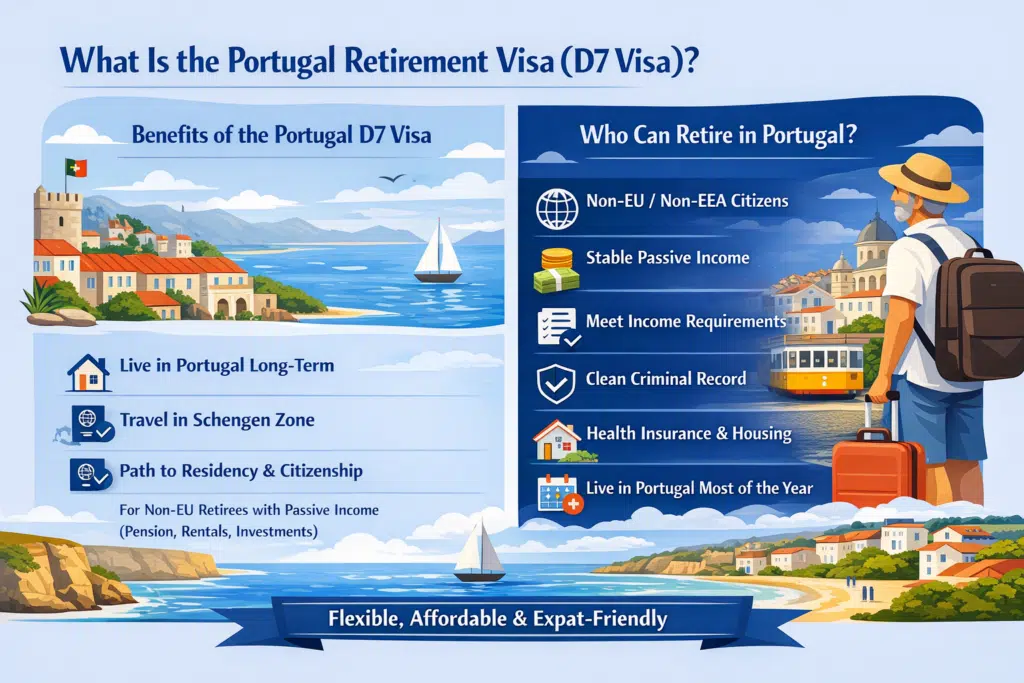
UK, USA, Canada, Australia, and other nations are especially popular because of retirees from these countries who want to spend their retirement in Europe, have good healthcare, and an affordable lifestyle.
Why Retire in Portugal? Key Benefits for Expats
Portugal has always been one of the most popular destinations among retirees, and with reason:
- Low standard of living as compared to other EU states.
- Good healthcare (both governmental and non-governmental)
- Safe, peaceful environment
- Mild climate year-round
- Uncomplicated visa route for retirees.
- Opportunities for family reunification.
- Eligibility for citizenship at the end of 5 years.
These are some of the benefits that make the Portugal Retirement Visa a wise decision for expats who are seeking a safe and comfortable European retirement.
Step-by-Step Process
It is a process of de-escalation of the entire process:
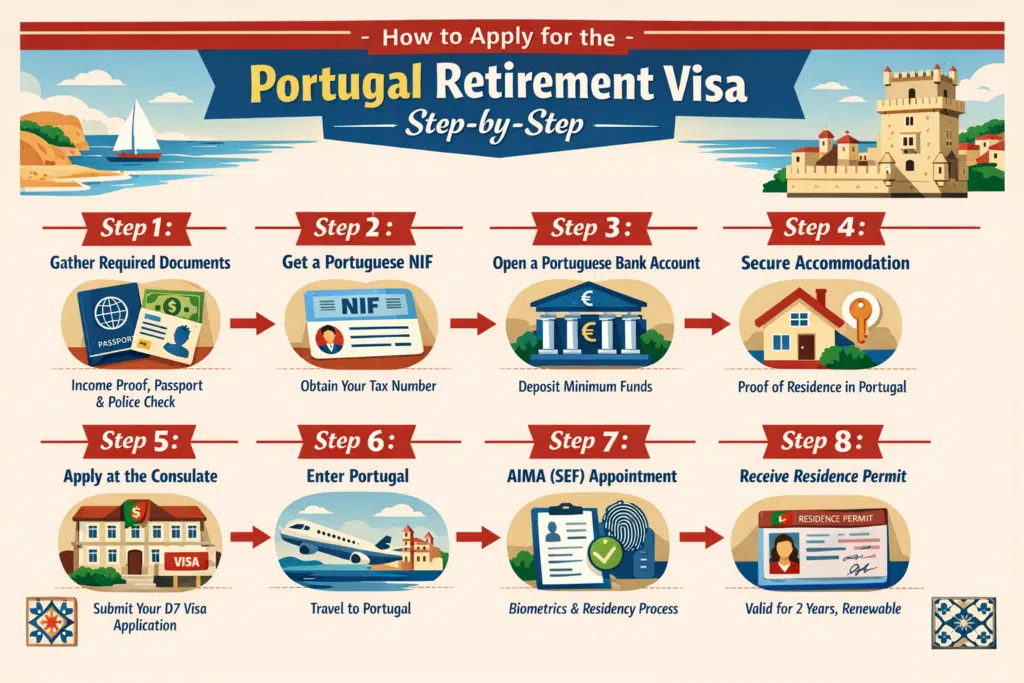
Step 1: Gather Required Documents
Obtain income paperwork, criminal record, passport, and insurance.
Step 2: Get a Portuguese NIF
Banking and rental tax identification number.
Step 3: Open a Portuguese Bank Account
Insert the necessary minimum deposit.
Step 4: Secure Accommodation in Portugal
Demonstrate evidence of permanent residency.
Step 5: Apply at the Portuguese Consulate
Make your D7 visa application in your country of origin.
Step 6: Enter Portugal
Upon approval, go to Portugal.
Step 7: Attend AIMA (SEF) Appointment
Observe biometrics and residency permits.
Step 8: Receive Residence Permit
Initially renewable for 2 years.
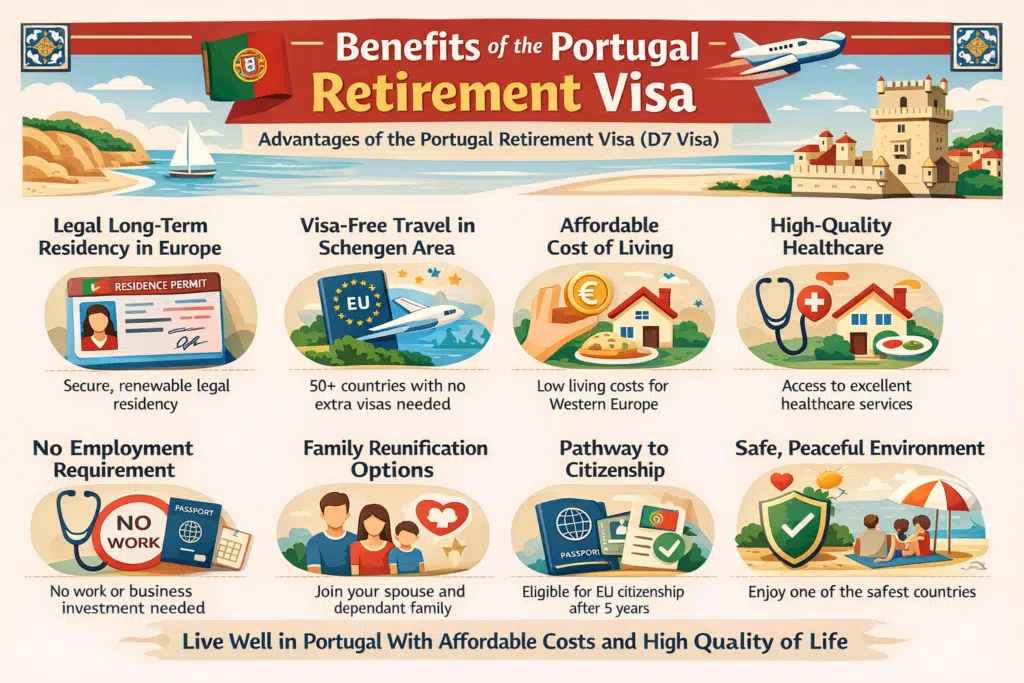
Benefits of the Portugal Retirement Visa
The Portugal Retirement Visa does not simply provide the privilege to reside in a foreign country. It offers the retirees the position of a secure legal establishment, prolonged stability in Europe, and the chance to access one of the highest-quality lifestyles at comparatively low expense. The following are the main advantages that qualify Portugal as a great retirement place among expatriates.
Legal Long-Term Residency in Europe
The Portugal Retirement Visa is the opportunity that permits retirees to have a legal residency in Portugal and an initial residence permit, which may be renewed and results in permanent residency after five years. This is a long-term security, hence suitable for the people whose long-term strategy is to permanently move to Europe.
Visa-Free Travel Across the Schengen Area
The retirees are also free to move around the Schengen Zone since they are of Portuguese origin, and hence visiting other European states without additional visas is very easy.
Affordable Cost of Living
The cost of living in Portugal is among the lowest in the west of Europe. The retirees will be able to spend their time in comfortable housing, eating, transport, and other day-to-day activities at much lower costs than in other countries such as France, Germany, or the UK.
Access to High-Quality Healthcare
The retirees are also free to move around the Schengen Zone since they are of Portuguese origin, and hence visiting other European states without additional visas is very easy.
No Mandatory Employment Requirement
The Portugal Retirement Visa is specially created to cater to the needs of financially independent people; you do not have to work or start a business to continue being a resident.
Family Reunification Options
With this visa, the retirees can carry along spouses and dependent family members, thereby making settling in Portugal easier and being in retirement much easier as a family.
Pathway to Permanent Residency and Citizenship
Retirees are welcomed to live as long as five years in Portugal and then are offered the opportunity to get permanent residence or become Portuguese citizens and enjoy the long-term rights in the European Union.
Safe, Peaceful, and Welcoming Environment
Portugal is never left out as one of the safest countries in the world. The retirees, especially, have made it their favorite due to the friendly culture, large expatriate population, and relaxed living.
Ideal Climate and Lifestyle
Portugal enjoys good winters, sweltering summers, and an easy way of living, which leads to a healthy lifestyle and long-term health.
Read Also: Do US Citizens Need a Visa for Greece?
Portugal Retirement Visa Requirements (D7 Visa)
The following are the requirements to be eligible under the Portugal Retirement Visa:
1. Passive Income Requirement
You have to demonstrate stable passive revenue that satisfies the minimum requirement of Portugal.
Minimum Income (Approximate):
- Single applicant: €820–€900 per month
- Spouse Married woman: 50% extra to spouse.
- Each dependent: Additional 30%
The following sources of income are accepted:
- Pension schemes of the government or private.
- Rental income
- Dividends or investments
- Long-term savings (with proof)
2. Financial Proof
- Portuguese bank account that is well-endowed.
- Bank statements (usually last 6 months)
3. Accommodation in Portugal
- Leasing or owning property.
- Preferably, long-term accommodation.
4. Other Required Documents
- Valid passport
- Health insurance coverage
- Clean criminal record certificate.
- Portuguese tax number (NIF)
Cost of Applying for the Portugal Retirement Visa
It would be wise to know the costs:
- Visa application fees
- Health insurance costs
- Translating and notarizing documents.
- Legal or consultant fees (optional)
Estimated Monthly Living Cost:
- Single retiree: €1,200–€1,700
- Couple: €2,500–€3,000
The retirement in Portugal is still one of the cheapest in Western Europe.
Living in Portugal as a Retiree
It is also factual that the cost of living in Portugal is low, especially when compared to other Western European countries. The retirees can afford to live in certain aspects of their everyday life, such as food, transport, eating, and utilities. Housing is affordable depending on the place of residence, and small cities and coastal towns are particularly good.
Cost of Living for Retirees
It is also true that the cost of living in Portugal is low, particularly in comparison to other Western European nations. Daily cost of living, like food, transport, eating, and utilities, is affordable to the retirees. Depending on the location, housing is affordable, and small cities and coastal towns are especially good.
Healthcare Access and Medical Services
The healthcare system is of high quality for the retirees residing in Portugal. In the event of attaining residency, expats will be able to utilize the state-provided healthcare network, although the cost of private healthcare is relatively low and it is well-spread. Most of the physicians understand English, and this has simplified the process of medical care amongst the global retirees.
Housing and Accommodation Options
The retirees are afforded a very good range of houses, including apartment buildings, villas, and permanent rent. The Algarve, Porto, and the Silver Coast retirement destinations have comfortable houses at lower prices than the major metropolises in Europe.
Lifestyle and Daily Life
Portugal boasts of an extremely slow way of life that is ideal for a retiree who is willing to relax. Countries are often grounded in outdoor activities, cafes, the local markets, and social events. The climate in the country is mild, and this will provide the retirees with a chance to walk, sightsee, and relax throughout the year.
Safety and Community Life
Portugal is a secure country, and it is rated among the safest countries in Europe, thus attractive to retirees. Pleasant groups of expatriates also provide social support, and the welcoming culture of the locals helps the retired individuals to integrate with the Portuguese society.
Transportation and Connectivity
Portugal has good and inexpensive transportation, especially in the capital of the metropolis. Through the good transport network in Portugal, the retirees are able to move easily in and out of the country and the rest of Europe.
Language and Cultural Adaptation
Most locals, particularly in the healthcare, government offices, and expats regions, speak English, although learning the basic Portuguese language is quite beneficial. This simplifies the process of settling down in Portugal among the retirees.
Best Places to Retire in Portugal
The correct city can make your retirement life many times better:
- Lisbon, Excellent, modern, and vibrant healthcare.
- Porto -Cultural allure and reduced cost of living.
- Algarve -Best retirement destination, sunny and easy-going.
- Silver Coast -Cheap and not overcrowded.
The country will fit in the various types of retirement choices, as each area is a different experience.
Frequently Asked Questions About the Portugal Retirement Visa
Is it possible to work on a Portugal retirement visa?
Yes, there are limited professional activities when having the D7 Retirement Visa.
Can I bring my spouse?
Yes, there is family reunification that can be done with a Portugal Retirement Visa; that is, you can bring your spouse and dependents.
How long does approval take?
The visa processing time is too slow, and it would take 2-4 months, depending on your nationality and documentation.
Can I apply from my home country?
Yes, you need to apply to the Portuguese consulate or the embassy in your home country for all D7 visa applications.
Read Also: Do U.S. Citizens Need a Visa for France
Final Thoughts
The Portugal Retirement Visa is an excellent opportunity to have a safe, cheap, and enriching retirement in Europe. Considering a clear application process, good income standards, and high standards of living, Portugal is still an attractive country to retire to in the world.
Planning, pack your papers, and start the European retirement in Portugal.