
Do you intend to study, work or live in Spain in the year 2026? Then, you must know about the major changes in the residency and immigration policies in Spain that are changing the ways through which people can gain access to legal residency. You are already here in Spain illegally, you are a student, you are a digital nomad, you are joining your family, you are in search of your beloveds; this twist of fate may accelerate, simplify, and make this process more open than ever before.
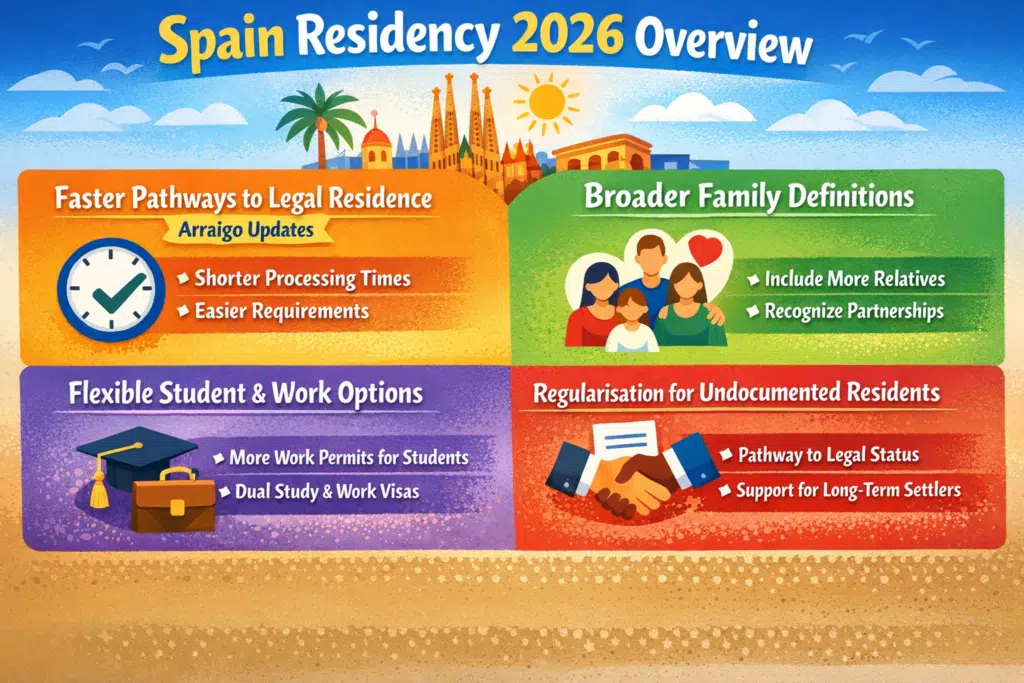
I will also take you through all the new provisions in this guide, such as the mass regularisation of undocumented residents, the revamping of the Arraigo system, changes to students and digital nomads, changes to family reunification, and making the immigration process digital.
Mass Regularisation Campaign
The Mass Regularisation Campaign is one of the most important changes that have taken place in the immigration system of Spain; a legalisation campaign targeted at undocumented migrants already residing in Spain. I would like to deconstruct how exactly this is going to work and what it will mean to you.
What the Campaign Offers
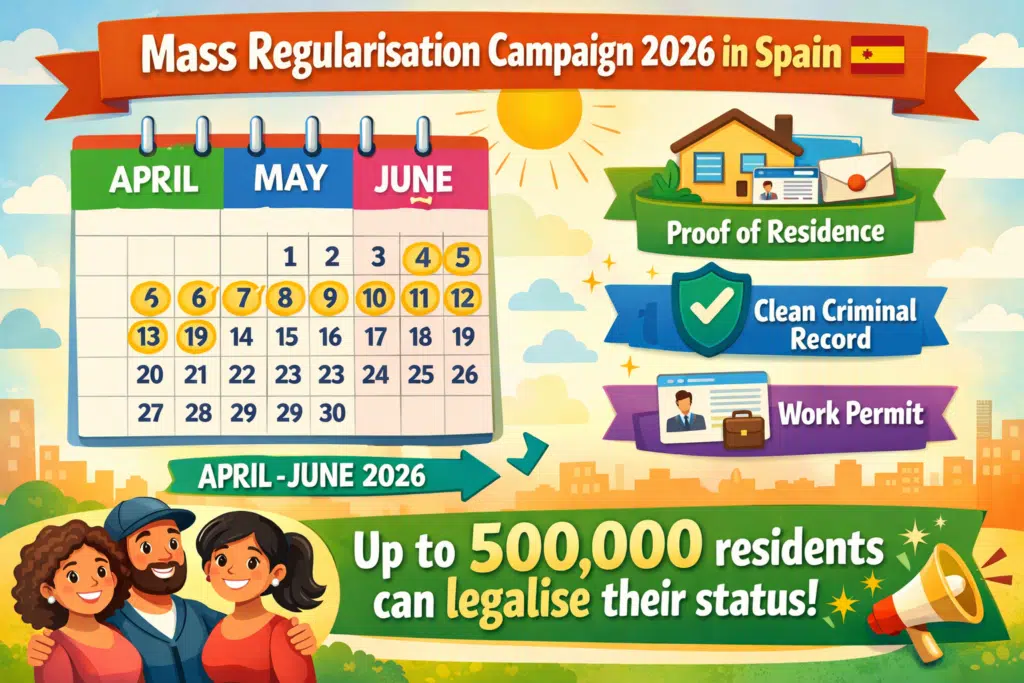
The Spanish government has provided a temporary period (which is projected to last between April and June 2026) during which undocumented residents can seek temporary residence and work permits. The following are the main requirements that you should have:
- Continuous residence before 31 December 2025
You must have been a resident of Spain, without having left there before this date. - Proof of residency for at least ~5 months
I would suggest retention of utility bills, rental agreements or official letters as evidence. - Clean criminal record
The police will demand that you do not have a major criminal record.
Who Can Benefit
This programme may assist up to half a million people who are not legally governed at the moment. This is an opportunity of a lifetime; you have a chance of legalizing your residency in a short period of time and also get access to work permits, as well as protect yourself against future risks of litigation.
Overhaul of Spain’s Residency System
Besides the regularisation campaign, Spain has also enacted a total overhaul of its residency system with Royal Decree 1155/2024, which has been fully implemented on 20 May 2025. I would like to describe the impact of these developments on various avenues to residency.
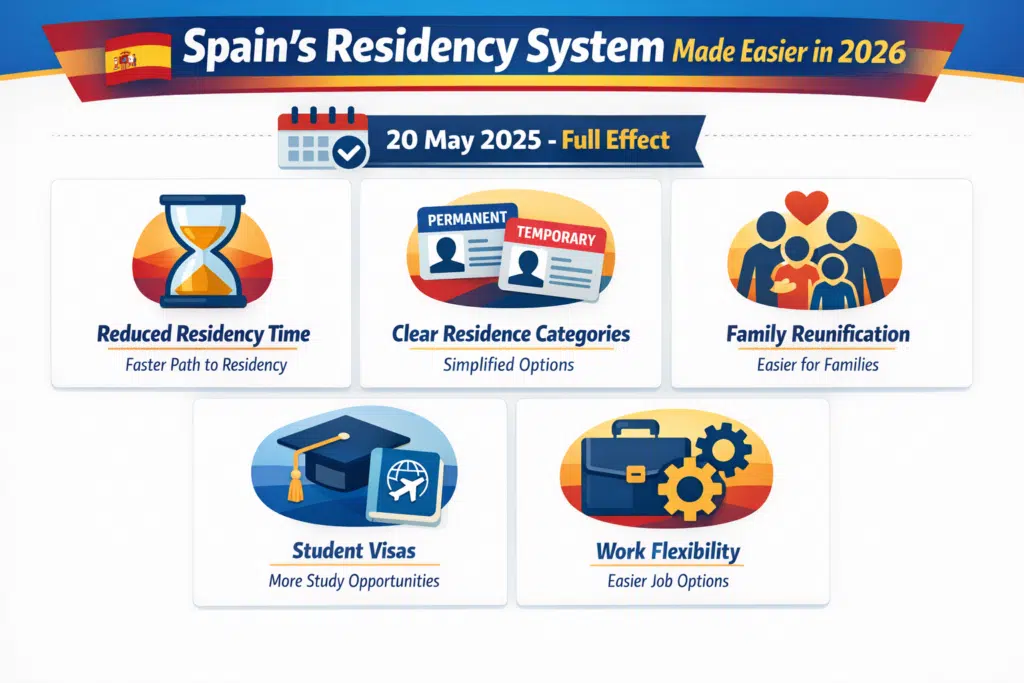
Key Changes Introduced: Reduced Residency Time Requirements
- Numerous routes, such as Arraigo, will have 2 years of uninterrupted residence requirement rather than 3.
- This makes it faster for you to move from irregular to legal status.
Clear Classification of Residence Categories
The new law will categorize permits in different categories:
- Socio-labour permits – to have employment-based residence.
- Social permits – for special social conditions of people.
- Educational pathways – for students.
- Second-chance permits – to those who had lost their legal status.
This classification makes it easier for you to identify which permit matches your situation.
Improved Family Residence Rules
- The definition of family has been expanded: now, children to the age of 26 years, unregistered partners, and extended relatives are included.
- Part of the financial requirements to reunite with family members has been eliminated, and nowadays, the family can cohabit on legal grounds easily.
Student Visa Changes
- The new study permits are going to extend to the entire course term, meaning you will not need to have yearly renewals.
- Part-time employment is permissible, and work boundaries are now demarcated.
Work-and-Self-Employment Flexibility
- Now, the employee residents are able to freelance or begin a small business without the necessity to obtain a separate permit.
- The change is more flexible for individuals who may want to have both traditional employment and self-employment.
Arraigo System: Easier & Faster
The Arraigo system that enables residency on social or work connection has been significantly revised. I would like to ensure that you know how to gain.
What’s New in Arraigo
Reduced Continuous Residence Requirement
- It now requires only 2 years of legal residence in Spain as compared to 3 years.
Multiple Pathways
- Social Arraigo- those who are capable of integrating socially, such as community participation.
- Socio-labour Arraigo – in the case of people associated with the work or contracts.
- Other pathways – depend on your personal circumstances.
Job Contract Not Always Required
- There are no longer job contracts needed in some Arraigo permits.
- Rather, income or savings will do, and this will aid you in case you are financially independent.
This makes it much simpler and quicker for you to be able to change your irregular status into legal residency in the event that you have already been living in Spain for a couple of years.
Student & Digital Nomad Changes
Spain has also changed, as well as digital nomads and students, and I would like you to know about those changes.
Student Visa Updates
- Visas have also been extended to the full term of your course of study, and this is less pressure on the administration.
- Part-time employment during studies is specifically allowed with a more definite limitation on hours.
- This will provide a more stable environment to the international students.
Digital Nomad Rules
- Draft rules suggest higher minimum income requirements.
- There may be a need to provide documentation to establish stable remote employment and tax residency intentions.
- Though not all the rules have come into effect yet, as a remote worker, you should expect more restrictive conditions if you want to live in Spain.
Golden Visa Programme Is No Longer Available
The Golden Visa scheme, enabling residency with huge investments (e.g., investing 500,000 in real estate) of Spain, has been officially terminated for new applicants.
- Existing holders can continue renewing their permits under the old terms.
- Other avenues, like socio-labour, social or Arraigo approaches, will have to be considered by the new applicants.
This is a change in direction of investment-based residency to employment, social integration, and study.

Digitalisation of the System
A centralised digital immigration portal is slowly being implemented in Spain and it is a significant move towards simplifying the residency process.
Benefits of Digitalisation
- Standardised application requirements across all regions.
- Less paperwork- no longer too much paperwork in various municipalities.
- You can track the status of your application online, and it is easier.
This electronic platform will eventually accelerate authorisations and reduce the geographical discrepancies to save you time and anxiety.
Frequently Asked Questions (FAQS)
Who can apply under the 2026 regularisation?
Illegal immigrants in Spain as of 31 Dec 2025, whose status as an undocumented resident was established over 5+ months and had a clean criminal record.
What is Arraigo and what’s new?
In Arraigo, one can be a resident through social or employment connections. Today, 2 years of residence are sufficient and certain permit do not need a job contract.
Is it possible to accompany me with my family?
Yes – children to 26, unregistered partners, and some extended family.
How long are student visas valid?
They now run the entire period of your course, and permit the taking of part-time employment.
Am I able to work on a freelance basis on a residency permit?
Yes, there are now numerous permits that can be used together with traditional employment: the freelance or self-employment.
Read Also: Italian Citizenship by Descent: Eligibility, Rule & Timeline
Final Thoughts
As I have described, the new residency regulations in Spain in the year 2026 are a huge opportunity for both the undocumented migrants and the legal immigrants. I strongly recommend that you evaluate your eligibility for Arraigo, student visas, or the mass regularisation programme as soon as possible.
- Keep all residency proofs ready.
- Have a clean criminal history.
- Visit online submission sites in order to accelerate your application.
- In case you have a family, they should also see whether they fit the new family definitions.
The trend in Spain is evidently towards a more adaptable, accommodating, and open immigration policy, and knowing this early will assist you in maximising on this development.