

Is your family of Italian origin already Italian citizens?
Italian citizenship by descent is one of the most useful and inaccurately understood modes of gaining European citizenship. They believe that to be eligible, one must be born in Italy, yet Italy has its own rules. It is by blood that citizenship is inherited and not by place of origin, and thus, your Italian parent or ancestor may already have given you a legal claim to citizenship.
In this guide, I will explain how the Italian citizenship by descent operates, who is eligible, the provisions that are supposed to take priority, and pitfalls that ought to be circumvented.
What Is Italian Citizenship by Descent?
This right of blood is the legal concept that has been applied to determine Italian citizenship by descent and is referred to asJure Sanguinis. Italy does not confer citizenship based on place of origin; it does so based on ancestry.
They do not consider where one was born, but the parents were in Italy.
In simple terms:
- Having a dad or mom who is Italian, then you, by birth, are Italian.
- It does not matter where you were born.
- It is your bloodline that determines the right to citizenship.
The Italian law has a well-established rule and has been maintained over the generations.
Italian Citizenship Law
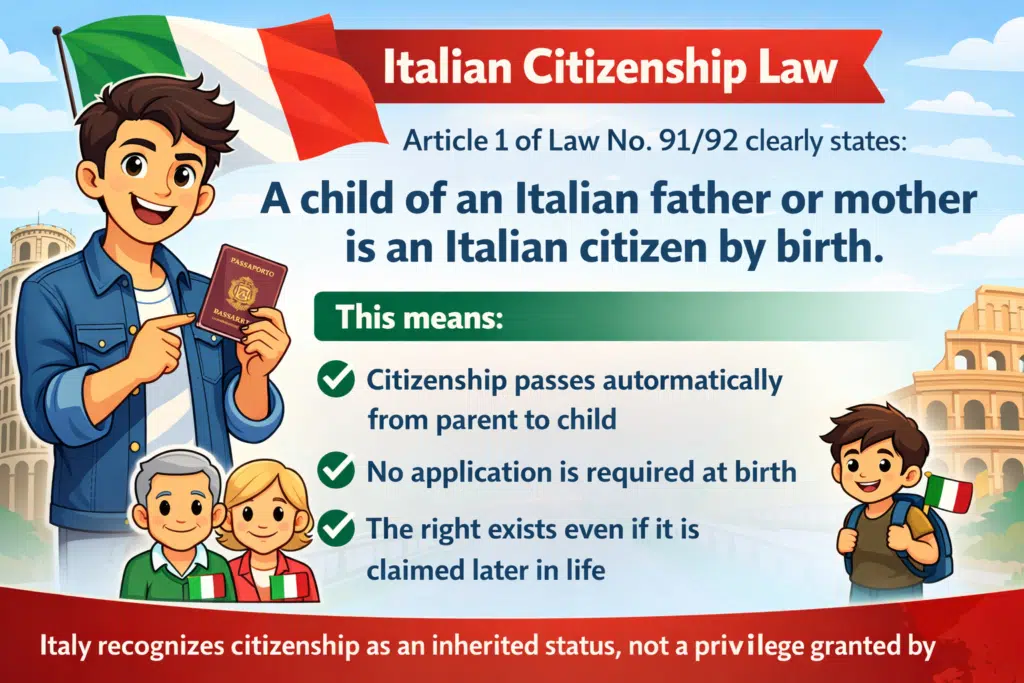
As it is stated in Article 1 of Law No. 91/92 it states:
An Italian citizen is born to an Italian family where the mother or father is an Italian.
This means:
- There exists an automatic citizenship transmission.
- It does not require any application at birth.
- The right is also still valid when it is late in life.
The notion of citizenship is not appreciated in Italy as a sense of inherited emotion, but as a privilege of place.
Additional Requirements
The requirements are contained in the Legislative Decree no.36/2025, of March 28, 2025, which was subsequently turned into law on May 24, 2025 (Law No.74/2025).
- Only Italian citizenship – You cannot own or have any other nationality than Italian citizenship.
- Italian parent or grandparent only – either of them must have been purely Italian at your birth or their passing.
- Parent lived in Italy – your Italian parent must have lived in Italy 2 years consecutively since becoming an Italian, before you were born or adopted.
What Happens If None of These Conditions Apply?
If any of the above requirements are not met, one might find that Italian authorities deny citizenship by descent even though you have Italian ancestry.
The One Rule That Truly Matters
The Italian citizenship by descent is very generous; however, the Italian citizenship by descent has one condition that you ought not to overlook.
Your Italian father must have been an Italian:
- At the time of your birth, and
- Until you turned 18 years old
If your parent:
- Renounced Italian citizenship, or
- The citizenship of the Italians is not then devolved to you.
Then, Italian citizenship does not pass to you.
This one rule can be called the majority of the rejections, and thus, carefulness before application should be applied to this rule.
Who Is Eligible for Italian Citizenship by Descent?
You may qualify if:
- When you were born, your father was an Italian or your mother was an Italian.
- Your Italian parent has not hitherto renounced citizenship during your 18th year of age.
- The family relationship is one that can be supported using official documents.
You may also qualify through:
- Italian grandparents
- Great-grandparents
- Earlier generations (in many cases)
In Italy, there is no limit of generation as long as citizenship was not infringed upon at any time in the family lineage.
Italian Citizenship by Descent Through Parents
This is the most straightforward case.
You qualify if:
- One of your parents was an Italian.
- When you were a minor, your father remained an Italian.
- You are able to provide birth certificates of the relationship.
In this case, you are an Italian by birth, but you might not have registered your citizenship.
Citizenship by Descent Through Grandparents or Ancestors
Not all people are aware that they can still qualify based on:
- A grandfather
- A grandmother
- A great-grandparent
As long as:
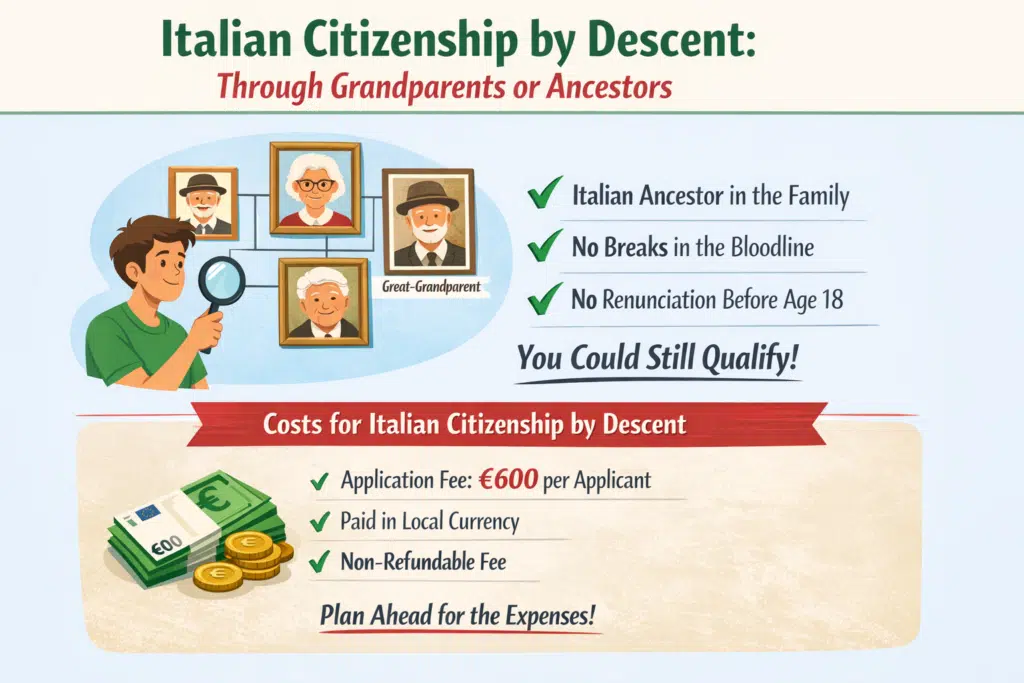
- Your ancestor was Italian
- The extension of the citizenship was uninterrupted.
- Until the other generation had reached the age of 18 years, no one in the lineage ever renounced citizenship in Italy.
An argument to make is still possible.
Costs for Italian Citizenship by Descent
The Italian government has defined a predetermined number of consular fee which is imposed on the majority of the applications that are submitted at the Italian consulates outside this nation.
Official Application Fee
- The standard fee is €600 (600 Euros)
- This is a fee that is paid on behalf of an applicant.
- It must be paid in the local currency, at the rate of exchange which the Italian consulate had fixed on the day of payment.
Such a fee is prescribed by Article 7 of the Italian Consular Fee Table and is not refundable even in case of delay or rejection of the application.
Step-by-Step Application Process
The notion is as follows in most instances:
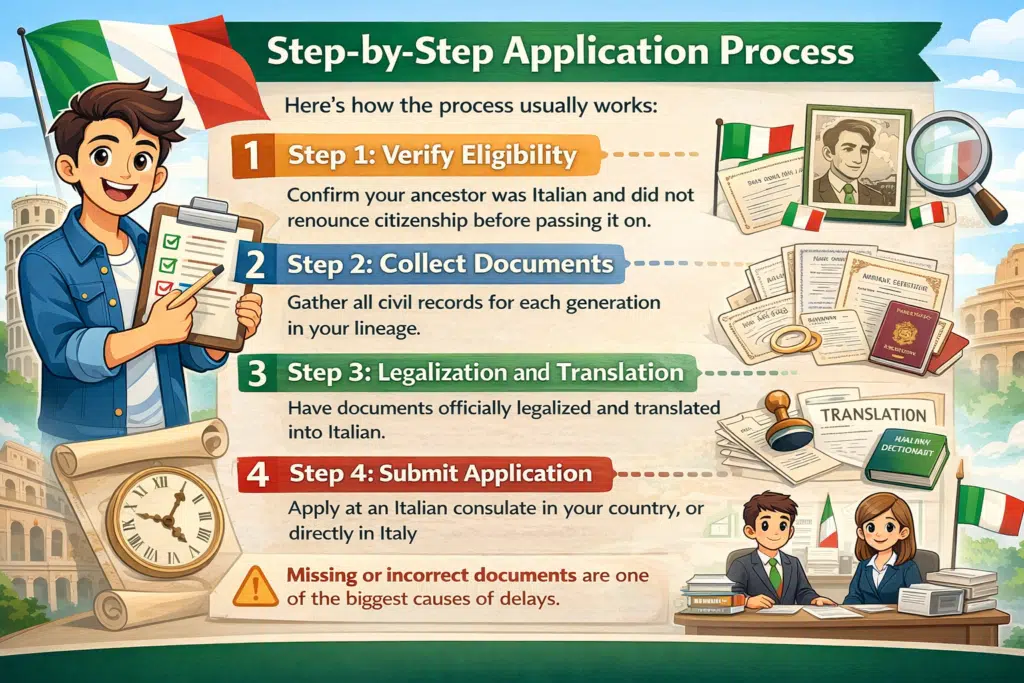
Step 1: Verify Eligibility
Ensure that your ancestor was an Italian and failed to renounce citizenship in case of passing away.
Step 2: Collect Documents
Incorporate all the civil papers of each generation of your blood.
All you need to do to prove your right is paperwork. Italian authorities are much rigid on official reports and not family accounts.
You will typically need:
- Birth certificates of all individuals
- Marriage certificates
- Proof of Italian citizenship for your ancestor
- Proof of residence in the State
- Naturalization or non-naturalization records
- Valid Passport
- Certificate issued by the competent authorities
One of the largest contributors to delays is the missing or wrong documents.
Step 3: Legalization and Translation
Documents will have to be made officially legal and translated into Italian.
Step 4: Submit Application
Apply either:
- In one of your Italian consulates, or
- Directly in Italy
Step 5: Wait for Review
The time taken to process cases varies with location and the complexity of cases.
How Long Does the Process Take?
Timelines depend on:
- Application method
- Consulate workload
- Document accuracy
Typical timelines:
- Consulate applications: 1–3 years
- Italy-based applications: 3–12 months
Errors may lead to years of delay, and hence preparation is important.
Common Mistakes That Get Applications Rejected
Avoid these costly errors:
- Missing documents
- Incorrect translations
- Name inconsistencies
- Wrong dates
- Assuming eligibility without verification
- Application without the naturalization history examination.
A single error may rewind the whole process.
Why Italian Citizenship by Descent Is So Valuable
Italian citizenship gives you:
- EU passport
- Right to live and work in all EU countries
- Access to European healthcare and education
- Visa-free travel to 180+ countries
- Citizenship, which is bequeathed to the generations to come.
It is more than paperwork, and it is a lifetime value.
Frequently Asked Questions (FAQ)
Is the place of birth a concern for Italian citizenship?
No. Italy does not give citizenship based on place of birth but on blood.
Is it possible to apply in case my grandparent was an Italian?
Yes, as long as citizenship was not lost before the next generation turned 18.
What would happen to me if my parents became citizens of a foreign country?
In case this was done prior to your 18 th year, citizenship is not inherited.
Do I need to live in Italy?
No. Residency is not required for descent-based citizenship.
Read Also: Job Market Research for Working in Germany (2026)
Final Thoughts
To my mind, Italian citizenship by descent is one of the most precious legal statuses that you can have if you are eligible. It links you with your past and opens the door in Europe, among others.
Lots of people postpone the process of application just because they do not know the rules. In case you take the time to check whether you are eligible and make sure you have the necessary documents ready, it will be much easier.