Spain is also one of the most attractive locations among the population of professionals, skilled workers, entrepreneurs, and remote workers within the context of Europe. Spain has great career and residence prospects, both short term as well as long-term, and this is due to its stable economy, good health care services, good living standards, and being a member of the European Union.
All the information is presented in this guide, including the types of visas, the requirements, what documents are required, what costs, how much time has passed, what the most common mistakes are, and what the long-term residence.
What Is a Spanish Work Visa?
A Spanish work visa is a long-stay national visa ( Type D visa ), which enables non-EU/ EEA/ Swiss citizens to reside and work within Spain.
If you are not a citizen of:
- European Union (EU)
- European Economic Area (EEA)
- Switzerland
You must obtain:
- Spanish immigration approval for work.
- A Spanish consulate work visa for a long stay.
It is only when you are approved that you can enter Spain and then apply for your residence card.
Do you need a work visa in Spain?
You need a work visa if:
- You are an Asian, African, Middle East or an American non-EU citizen.
- Your Spanish employer has offered you a job.
- You are planning to open a business in Spain.
- You are going to work in Spain on a contract with a foreign company.
You should not require a work visa if you are an EU citizen. In Spain, you are free to work and live.
Types of Work Visas for Spain
You need to select the right category before you make an application. Spain also has many work visa options depending on your career circumstances.
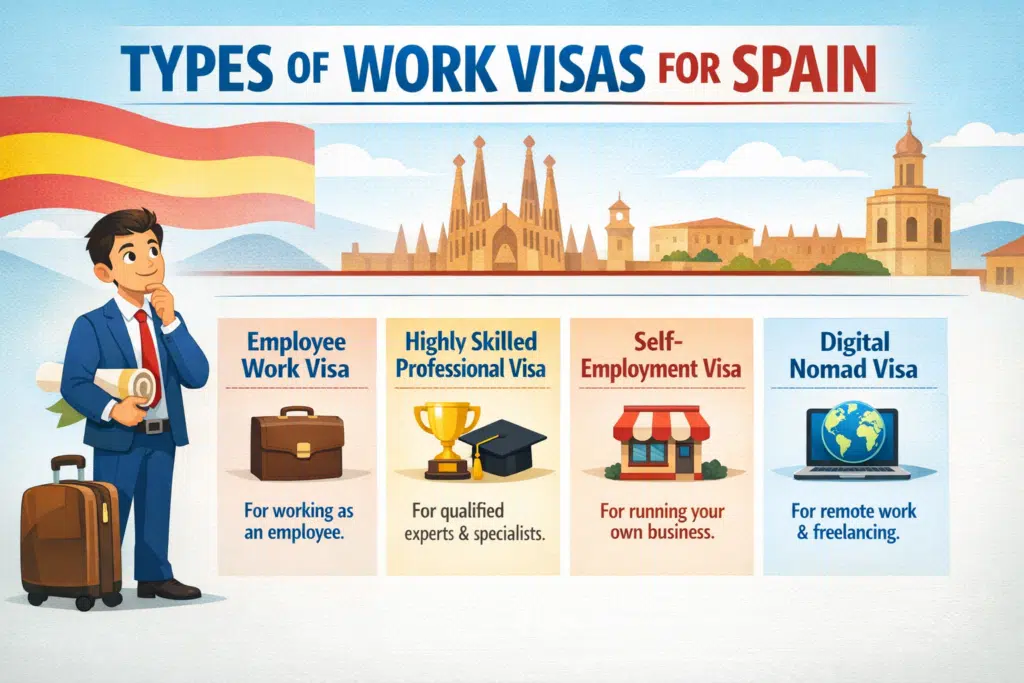
1. General Work Permit (Spain Employee Work Visa)
This is the most widespread work visa.
It is suitable for:
- People who have confirmed employment.
- Experienced and unskilled employees.
- Full-time contract workers.
- Construction, hospitality, IT, and non-healthcare workers, agricultural workers, and so on.
Note: First, your Spanish employer should seek work authorization. You cannot apply without the consent of the employer.
2. Spain Visa for Highly Skilled Professionals
This visa is designed for:
- Managers and executives
- Experts in engineering and IT.
- Experts having university education.
- High-salary positions
- Transfers of Multinational Companies
This group is handled by the Spanish immigration law on entrepreneurs and very skilled individuals.
Benefits include:
- Faster processing
- Simplified documentation
- Less taxing family reunification.
3. Spain Self-Employment Visa
If you want to:
- Start your own business
- Open a company
- Work as a freelancer
- Invest in Spain
You may utilize a self-employment residence permit.
You must provide:
- Detailed business plan
- Financial projections
- Proof of sufficient funds
- Professional qualifications
- Evidence of experience
Spain assesses keenly whether your business idea is viable.
4. Spain Digital Nomad Visa
The Digital Nomad Visa was also introduced by Spain to remote workers.
This visa is ideal if:
- You work online
- Your employer is not in Spain.
- You are a freelancer who has international customers.
- You run an online business
Key benefits:
- Reduced tax rates
- Liberal residency policies.
- Allows the ability to carry family members.
This visa has gained popularity among professional folks who are remote.
A Guide to getting a work visa to Spain step by Step
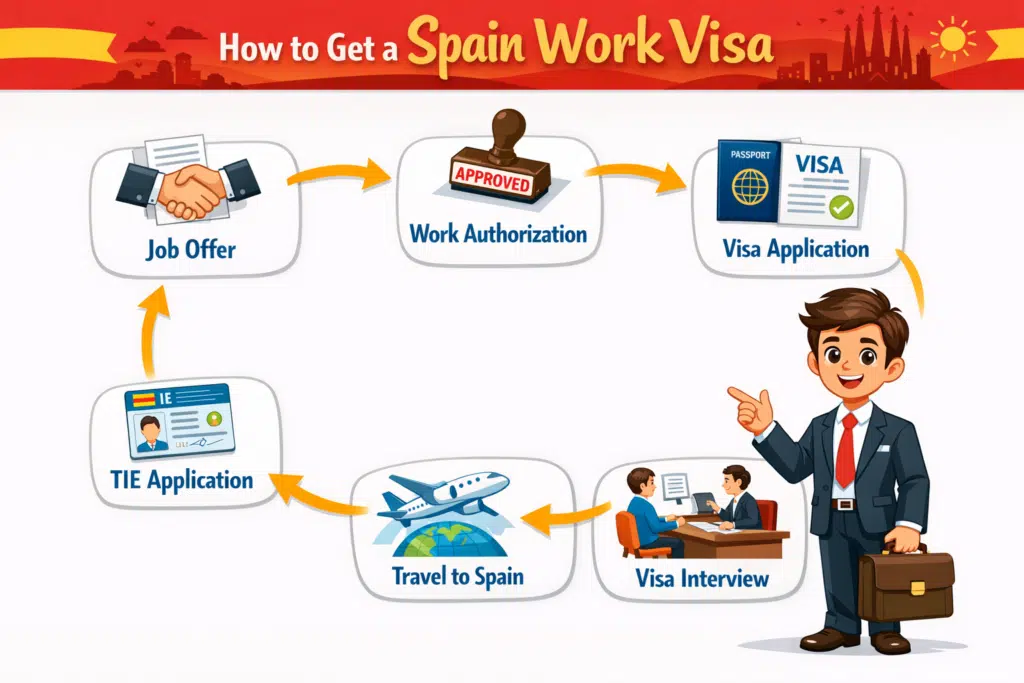
Step 1: Find an Offer of a Job in Spain
In the majority of work visas, the formal job offer is the first stage.
Your employer must:
- Sign a contract of employment.
- He or she must demonstrate that the job cannot be occupied by a Spanish or EU citizen.
- Send the work authorization application.
You cannot do this without being sponsored by an employer.
Step 2: The Employer requests the Work Authorization
It is the employer who presents the application at Spain Immigration Office.
The documents that are usually required are:
- Employment contract
- Registration documents of the company.
- Proof of salary compliance
- Reasons why it is best to hire a non-EU worker.
Step 3: Apply at the Spanish Consulate in Your Country
After a work permission is issued, you visit your local Spanish Embassy or Consulate, where you apply to be issued a Type D visa.
You must submit:
- Visa application form
- Work authorization approval letter
- Work authorization approval letter
- Signed employment contract
- Clearance certificate signed by the police
- Medical certificate
- Passport-size photographs
- Proof of accommodation in Spain
- Visa fee payment receipt
Whenever possible, it is always good to visit the Spanish consulate page in your locality to understand what is necessary.
Step 4: Attend Visa Interview
You might have to go through an interview.
Questions may include:
- What is your job role?
- Who is your employer?
- What is your salary?
- What is your interest in working in Spain?
- Have you traveled before?
Answer clearly and honestly. Your documents must be consistent.
Step 5: Accept a visa and Travel to Spain
If approved:
- The long-stay visa is going to be stamped on the passport.
- You must be subjected to the period of validity ( say 90 days)
Step 6: TIE (Foreigner Identity Card) Application
After arrival in Spain:
You have to get the TIE (Tarjeta de Identidad de Extranjero).
This card confirms:
- Legal residence
- Work authorization
- Foreigner Identification Number (NIE number)
You are to reserve at the local police station.
Spain Work Visa Application
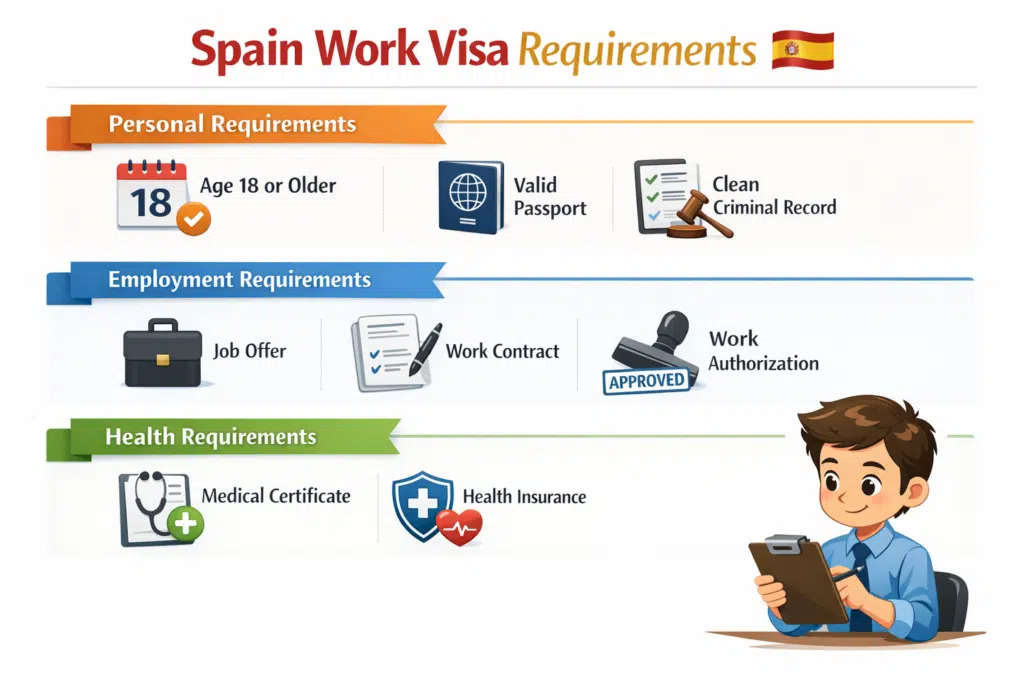
Personal Requirements
- Age 18+
- Authentic passport (must have a minimum of one year of validity)
- Clean criminal record
- None of the previous immigration infractions.
- No Schengen ban
Employment Requirements
- Official job offer
- Signed employment contract
- Work authorization is approved.
- Earnings in accordance with Spanish standards.
Health Requirements
- A letter of health stating the absence of contagious diseases.
- Health insurance
Spain Work Visa Fees
The prices are different in accordance with nationality and the type of visa.
Typical costs include:
- Visa application fee: €60–€100
- Residence card (TIE) fee: €15–€20
- Document translation and legalization: variable
Always confirm fees with your consulate before applying.
Processing Time in Spain Work Visa.
Processing time depends on:
- Visa category
- Country of application
- Rapidness of employer authorization.
- Volume of applications
Average timeline:
- Work authorization: 1–3 months
- Visa decision: 2–4 weeks
Plan and apply early.
Can You Bring Family Members?
Yes, Spain allows family reunification.
The eligible family members are:
- Spouse
- Dependent children
- In some cases, dependent parents.
Your relatives are provided with residence permits to live in Spain.
Your spouse can also be granted work authorization in certain instances.
Why is the Spanish work visa usually rejected?
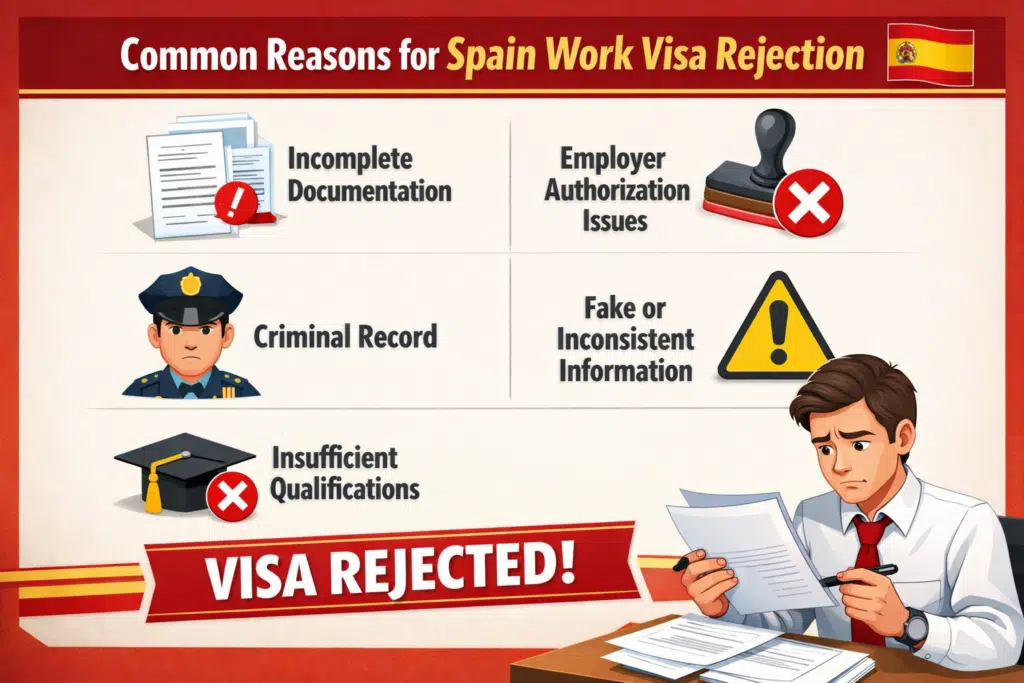
- Knowing the pitfalls will save you in terms of time and money.
- Incomplete documentation Wrong or misrepresented data.
- Authorization by the employer.
- Lack of professional qualifications. Wage that is lower than that which is needed by law.
Is a Spanish Work Visa the Way to Permanent Residency?
Yes.
You can apply for permanent residence after being given 5 years of continuous legal residence in Spain.
Permanent residency will enable you to:
- Live indefinitely in Spain
- Change employers freely
- Enjoy expanded rights
Ten years later (in the majority of cases), you can be a Spanish citizen, but it is a matter of nationality.
Benefits of Working in Spain
Employment in Spain is beneficial in several ways:
- Access to the EU labor market
- Well-favored laws on worker protection.
- Public healthcare access
- Paid annual leave
- Social security benefits
- Travel across the Schengen Area
- Balanced work-life culture
Spain offers both work-life and living standards.
Frequently Asked Question
1. How do you acquire a working visa in Spain?
The requirements are a minimum age of 18, a clean criminal background, a valid passport to work in Spain, a proven employment offer with a Spanish employer, and an employer work authorization.
2. What is the minimum work visa pay in Spain?
It will also depend on the job and visa type, but as a rule, the salary will be in accordance with the standard salary in Spain to the job; highly skilled job positions can be fixed at higher standards.
3. Which European nation is the easiest to find a work visa?
Portugal, Germany, and Spain are regarded as reasonably reachable to the skilled Pakistani labor, according to the job requirements.
4. How many years is a work permit in Spain?
Primarily 1 year with renewal after every year; long-term residence is then possible after five consecutive years.
Read Also: Check Traffic Fines in Spain Online (DGT & MiDGT 2026)
Final words
A work visa to Spain entails planning, cooperation of the employer, and proper documentation. This process can seem very complicated, yet it is easy to manage when these steps are divided into clear actions.
Whether you are:
- A skilled professional
- A contract-based worker
- An entrepreneur
- A remote employee
After a good plan, following the official procedure, and ensuring that all the papers are at the correct location, in 2026, you will be able to begin your adventure of working and living in Spain.