

Do you want to know how to receive citizenship in Portugal? Portuguese citizenship is a visa-free travel to more than 190 countries, full EU citizenship to reside and work in any country within Europe, and dual nationality. It is a growing trend among people who want to have long-term security and mobility around the world.
This manual describes all the procedures of attaining Portuguese citizenship legally, its eligibility, documents needed, steps of application, cost involved, and timelines of the process.
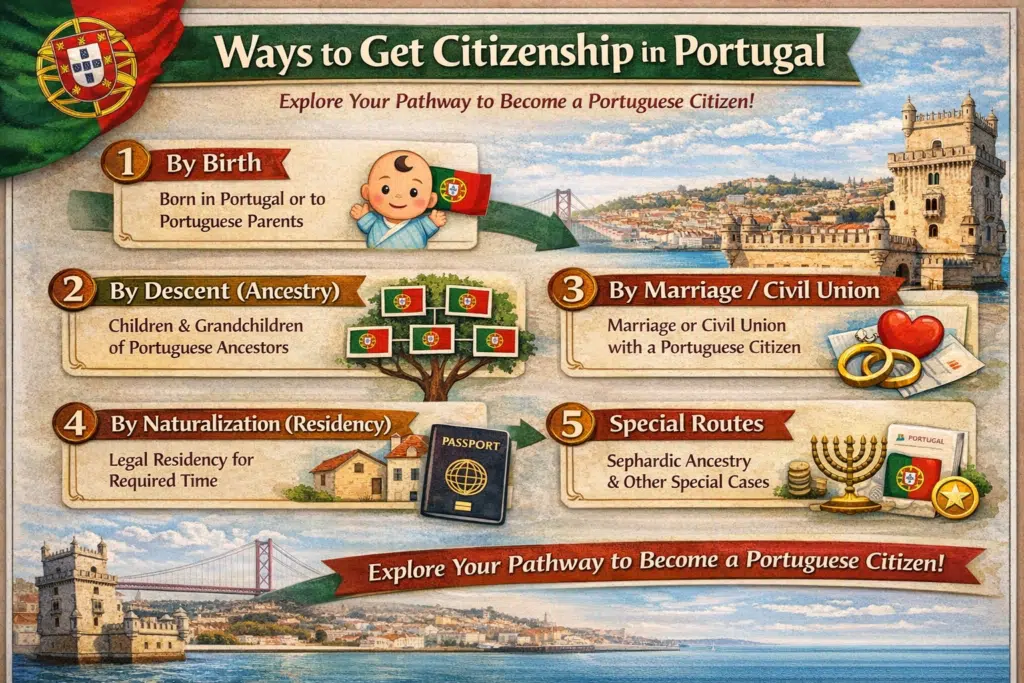
Ways to Get Citizenship in Portugal
Portuguese citizenship can be acquired through a number of legal ways. The routes will have their requirements, documents, and time of processing.
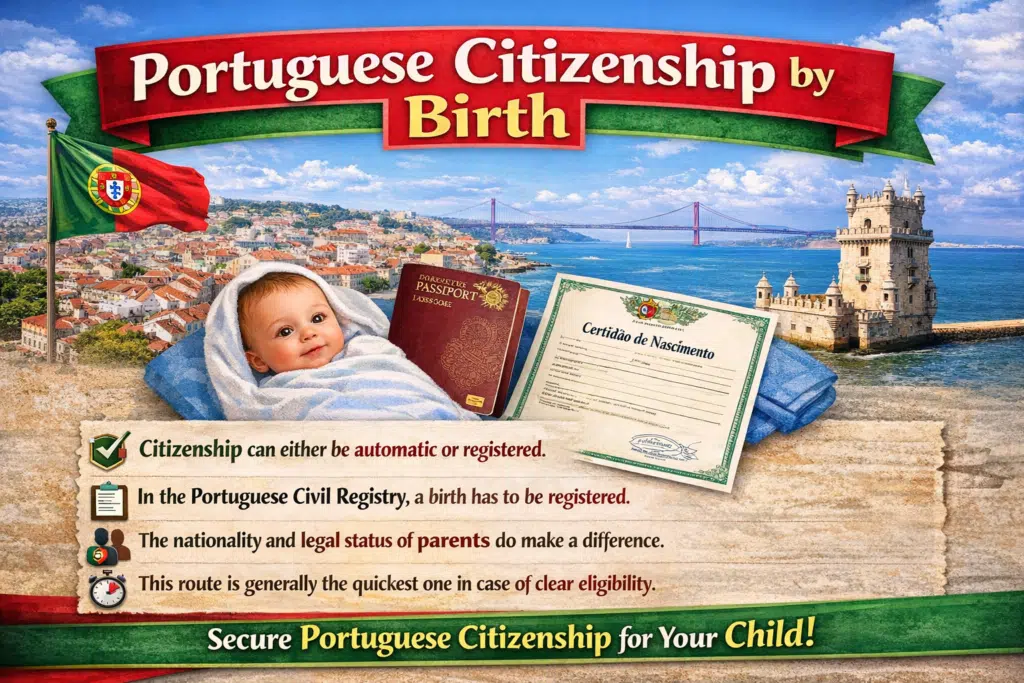
1. Portuguese Citizenship by Birth
You may, by birth, become a citizen, provided that you fulfil a series of conditions, first among them being a necessary requirement that you must have been born in Portugal or in a foreign state and that one of your parents must be a Portuguese.
Key points:
- Citizenship can either be automatic or registered.
- In the Portuguese Civil Registry, a birth has to be registered.
- The nationality and the legal status of parents do make a difference.
This route is generally the quickest one in case of clear eligibility.
2. Portuguese Citizenship by Descent (Ancestry)
Among them is citizenship by descent, which allows one to receive nationality through a Portuguese parent or grandparent, or in a small set of exceptions, a more distant lineage.
Who qualifies?
- Children of Portuguese nationals.
- The grandchildren of Portuguese nationals.
- Those who have Portuguese descent.
Key requirements
- Evidence of immediate family association.
- Portuguese forebears should be made legal.
- Civil and church records might be necessary.
This is the route that does not typically demand language skills of the children, yet the grandchildren might have to prove to be connected to Portugal.
3. Portuguese Citizenship by Marriage or Civil Union
In case you are married or in a legally established civil partnership with a Portuguese citizen, you can be eligible to become a citizen.
Requirements include:
- Civil union or marriage registered in Portugal.
- Duration of relationships (typically 3 years and above)
- Evidence of a legitimate relationship.
- Indications of connection to the Portuguese community.
Language proficiency is not a prerequisite, and the evidence of integration makes the application more effective.
4. Portuguese Citizenship by Naturalization (Residency)
One of the most common paths that are taken by foreign residents is naturalization.
Basic eligibility:
- Portuguese nationality required length of time.
- Valid residence permit
- Assimilation into Portuguese culture.
Previously, Portugal had required 5 years of legal residency, which may be modified in subsequent legislation. Make sure that you are not going against the law that is in place.
5. Special Citizenship Routes
There are special pathways also in Portugal, such as:
- Sephardic Jewish ancestry
- Superior service to the Portuguese state.
- In particular cases, former Portuguese colonies.
Every special route has its own documentation as well as eligibility requirements.
Read Also: Polish Citizenship by Descent: Eligibility, Rules & Timeline
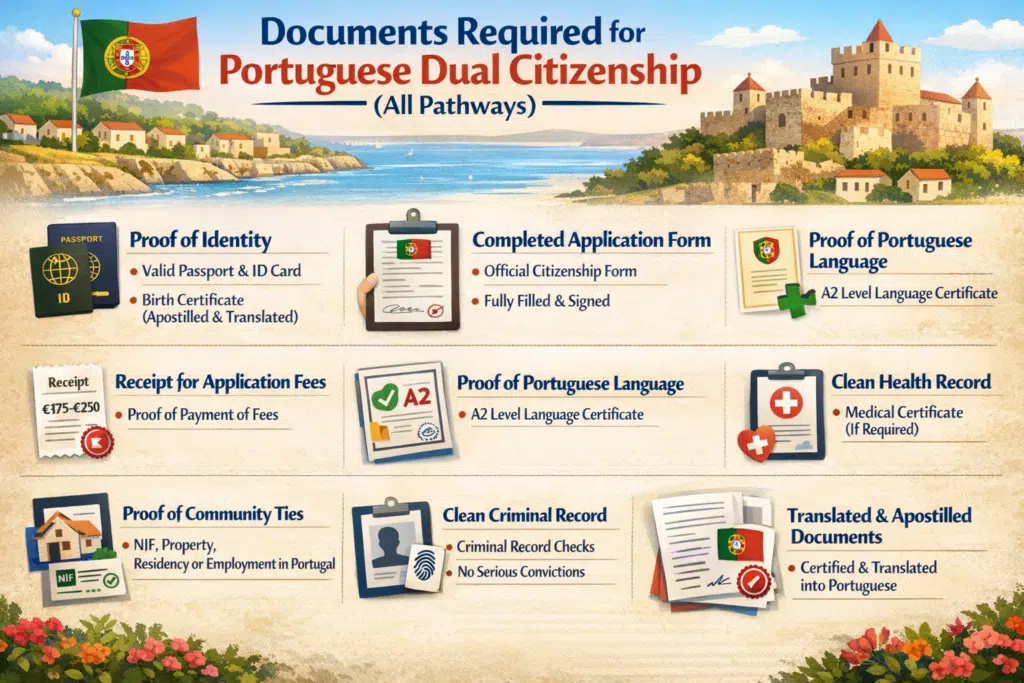
Documents Required for Portuguese Dual Citizenship
Irrespective of the route, Portuguese officials need a standard set of documents. To enable you to prepare, the breakdown has been given in full and expanded below.
Proof of Identity
- Valid passport
- National identification card (when needed)
- Birth certificate (apostilled and translated)
Completed Application Form
- Application form for Portuguese citizenship, official form.
- Fully completed and signed
- The right form will be based on the citizenship path.
Receipt for Application Fees
- Evidence of payment of government fees.
- The charges will usually vary between EUR175 to EUR250.
- The method of payment varies according to the location of application (Portugal or consulate).
Proof of Fluency in Portuguese
- A2 level certificate in the Portuguese language (CIPLE or other)
- Not necessary on all pathways (e.g., citizenship by descent for minors)
- The certificate should be given by a well-known institution.
Proof of Community Ties in Portugal
This is of particular significance to the descent, marriage, and naturalization applications.
Accepted evidence includes:
- Portuguese tax number (NIF)
- Residency records
- Ownership or leasing of property.
- Business or employment.
- Portuguese bank account
- Membership in the Portuguese cultural or community groups.
Clean Health Record
- Medical certificate
- Evidence that the candidate is not a threat to the health of the populace.
- Usually needed when it comes to residency applications.
Clean Criminal Record Background Check
- Criminal record certificate of:
- Country of nationality
- Country of residence
- Any country resided in for over 1 year.
- Was signed, translated, and apostilled in Portuguese.
- Should not have any grave criminal convictions.
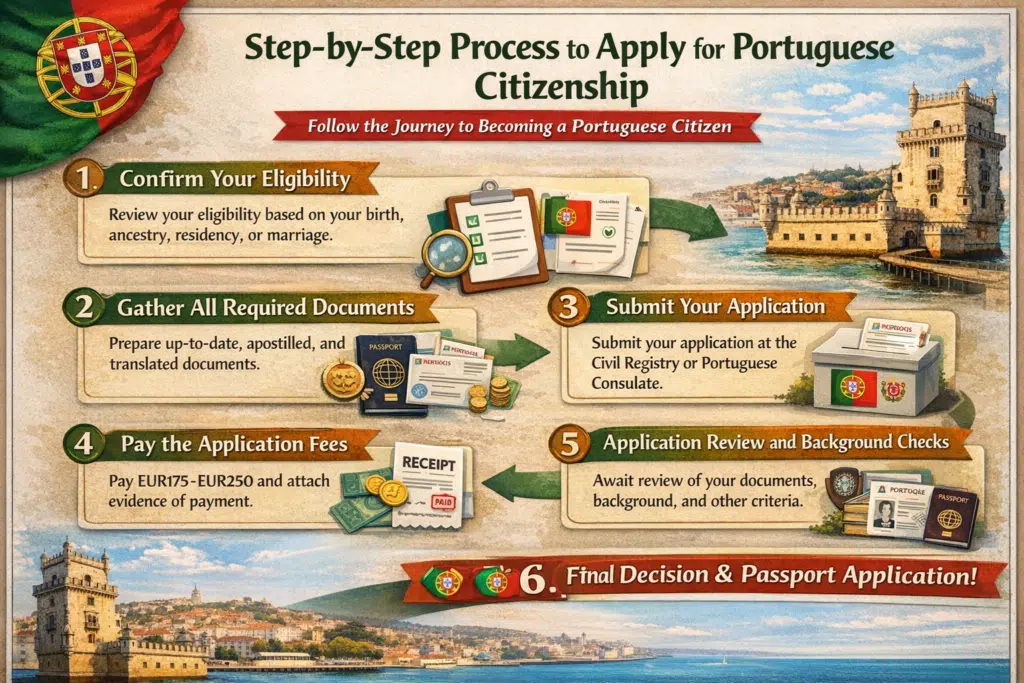
Step-by-Step Process to Apply for Portuguese Citizenship
Acquiring Portuguese citizenship is a legal procedure and should be adhered to strictly. Although the requirements differ slightly according to the pathway (descent, marriage, or naturalization), the general flow of the applications does not differ much.
Step 1: Confirm Your Eligibility for Portuguese Citizenship
The first and most significant one is to determine which citizenship route you can qualify for. Portugal is not quite helpless, and the misunderstanding of belonging to the wrong category is one of the most widespread reasons for refusal.
You should carefully assess your eligibility based on:
- Your place of birth
- Your parents’ or grandparents’ nationality
- Years of legal residence in Portugal
- Civil or marital union with a Portuguese citizen.
- Any special historical or legal association with Portugal.
Different pathways possess their legal preconditions, including language proficiency, evidence of community affiliation, or length of residence. Never underestimate to make sure you are ready, whatever route you choose to follow, before proceeding with it, to avoid the unnecessary hassle of having to extend your trip.
Step 2: Gather All Required Documents
Having the eligibility is followed by the second step of preparing documents. This is a step that in most occasions, may take the longest time, and one should be attentive to details.
All documents must be:
- Latest – the documents can become outdated and be rejected.
- Apostilled – to make international legal.
- Professionally translated into Portuguese – the translations should be certified.
Commonly required documents include:
- Birth certificate
- Passport or national ID
- Criminal record certificates.
- Proof of residence or community ties
- Marriage or lineage records (if applicable)
Late application is the most frequently encountered cause of application delays, and it is due to a lack of documents (or outdated or improperly formatted documents). There is much suggestion that the applicants would verify requirements and ensure that the requirements would be the same in all documents, especially names, dates, and spelling.
Step 3: Submit Your Portuguese Citizenship Application
After you have gotten all the papers, you need to present your application to the relevant authority.
The application can be submitted in two ways:
- In Portugal, in the Conservatorio dos Registos Centrais (Civil Registry Office).
- In a foreign land, by a Portuguese consulate in your native land.
Where you apply may depend on:
- Your current location
- The citizenship pathway
- Domestic consular processing durations.
In filling out your application, make sure:
- The right form of application is employed.
- All documents are included
- There are two certifications of copies.
Unfinished applications may either cause excessive delays in processing or an outright rejection.
Step 4: Pay the Portuguese Citizenship Application Fees
On submission, the official government application fee is required. Depending on the category of citizenship application, the fee charged may differ, but the normal fee is between EUR175 and EUR250.
Major considerations to be made:
- The way of payment is different depending on the place.
- The fees are never refunded.
- Always keep payment receipts
Evidence of payments is compulsory and must be attached to your application file. Lack of payment or giving confirmation may stop the entire processing.
Step 5: Application Review and Background Checks
The Portuguese authorities initiate an elaborate scrutiny once your application is approved. This phase requires different government departments and may take several months.
Authorities will verify:
- Validity of the documents provided.
- Relevant criminal background records of countries.
- Language skills, Portland tongue (where necessary)
- Indications of the integration and community in Portugal.
There are also stringent background checks, particularly for applicants for naturalization. Criminal convictions, which were serious or irregularities in records, may have a negative impact.
Applicants can be approached due to:
- Additional documents
- Clarifications
- Corrections
The fact that the response is delivered on time helps prevent time waste.
Step 6: Final Decision, Registration, and Passport Application
Portuguese citizenship is granted after the review process and the issuance of permission.
At this stage:
- Your citizenship is enrolled in Portugal.
- A Portuguese birth record is created or updated
- You are a full-blown Portuguese citizen.
After registration, you can:
- Apply for a Portuguese Citizen Card
- Apply for a Portuguese passport
- Have complete EU citizenship.
This is the last thing to do, and you have achieved your citizenship in Portugal.
Processing Time for Portuguese Citizenship
Processing times vary by route and case complexity.
Average timelines:
- Citizenship by birth: 12- 24 months.
- Citizenship by marriage: 18–30 months
- Naturalization of citizenship: 24 months and above.
Delays can occur due to:
- Missing documents
- Incorrect translations
- High application volume
Costs of Getting Portuguese Citizenship
Here is a realistic cost breakdown:
| Expense | Estimated Cost |
|---|---|
| Government application fee | €175–€250 |
| Language test (A2) | €70–€100 |
| Criminal record certificates | €25–€75 |
| Translation & notarization | €30–€100 per document |
| Legal assistance (optional) | €500–€2,000 |
Costs vary depending on the country and complexity.
Common Mistakes to Avoid
- Submitting incomplete applications
- Using uncertified translations
- Ignoring apostille requirements
- Applying under the wrong pathway
- Not proving community ties clearly
Such mistakes can be avoided so as to save months of waiting.
Frequently Asked Questions
Can one become a Dual citizen in Portugal?
Yes, yes, multi citizenship or dual citizenship, Portugal. You do not have to surrender the original nationality to become a Portuguese citizen except when your country of origin denudes you the dual citizenship.
How long does it take to get Portuguese citizenship?
The time taken in processing is dependent on the pathway:
- Citizenship by descent: 12–24 months
- Citizenship by marriage: 18–30 months
- Citizenship through naturalization: 24 months and above.
There may be delays when documents are lost, translated improperly, or those that need additional verification.
How much does Portuguese citizenship cost?
The cost of the government application is usually between EUR175 and EUR250. Other expenditures could be language tests, document translation, apostilles, and legal support. The total prices differ based on where you are and how complex the use of it is.
Can a person be a Portuguese citizen even when he is not residing in the country?
Yes, you can apply at one of the Portuguese consulates in your country of residence. Other candidates would, however, prefer to do it in Portugal, which is less time-consuming, and this is going to depend on the case.
Can my children get Portuguese citizenship if I become a citizen?
Yes, Portuguese citizens’ minor children are mostly allowed to apply for citizenship. The process is less lengthy, and documents are reduced on most occasions.
Read Also: Job Market Research for Working in Germany (2026)
Final Thoughts
Portugal has one of the best and most flexible citizenship programs in Europe. Having many possibilities, decent conditions, and dual nationality, it is a great choice for individuals and families who want to be stable in the long run, have the opportunity to move worldwide, and have access to the EU.
Providing you pack your documents well, take the right path, and go through the official process step by step, then it is entirely possible to become a Portuguese citizen.