
Is Italy a visa-free country for Americans? As a US citizen, you have to make sure that you keep yourself informed about any new entry requirements, so that you are able to make plans to visit the country in the future, not later than the year 2026.
American citizens are not required to obtain a visa to visit Italy during short-stay (under 90 days) trips. But they will need a national visa when they spend more than 90 days in the country, and U.S. nationals will also need an ETIAS authorization to travel beginning in 2026.
In this guide, I am going to tell you all about Do Americans need a Visa to visit Italy in detail and clarify all its requirements.
Short Stay in Italy (Up to 90 Days)
No Visa Required for U.S. Citizens
An American citizen is not required to have a visa to travel to Italy for short visits of less than 90 days, but for a period of up to 180 days. This is possible since Italy belongs to the Schengen Zone and American passport holders can access this country on a short-term visa-free basis.
Purpose of Short Stays
You don’t need a visa, and you don’t have to quarantine to come to Italy for the following reasons:
- Travel: Visiting the popular places like Rome, Venice, Florence, or Milan.
- Business Trips: Any business-related conference, meeting, or short trip.
- Family or Friends Visit: One can pay a visit to relatives or friends in a short period of time, or
- Travel – travelling through Italy to another Schengen destination
Passport Requirements for Entry
Although you don’t need a visa, you must have a valid passport to enter the country, and it must be up-to-date according to the requirements of the Schengen area.
- It must be valid for at least 3 months later than the day you plan to leave Italy.
- It must have been written in fewer than 10 years.
Therefore, I suggest that you check twice the date of your passport, which has expired, before you book any tickets. This small detail is forgotten by many travellers who get into trouble at the automatic machine.
Schengen 90/180 Rule
The other thing is the 90/180 rule. The maximum stay in Italy is 90 days. This means that if you have spent time in any other Schengen country for a total of 90 days, then you can’t enter Italy for more than 90 days.
What You May Be Asked at the Border
Italian border control officers might ask you to show them documents such as:
- Return or onward ticket
- Booking of a car or hotel/company accommodation
- Money to support your stay
- Health and emergency travel insurance
Although I didn’t have to submit them during my visa application to enter Iceland, I found that the border officers
Long Stay in Italy (More Than 90 Days)
When You Need a Visa
If you would like to remain in Italy for more than 90 days, you will have to apply for a National Visa (D visa). This is for Americans who are going to:
- Work in Italy
- Research at an Italian university
- Live in Italy with family
- Retire and settle in Italy
Types of Long-Stay Visas
Depending on the purpose of visiting Italy, there are different visa categories offered by the Italian Embassy or Consulate:
- Work Visa: for those with a work contract from an Italian company
- Study Visa: For students registered in Italian universities and courses of the Italian language
- Family Reunification Visa: for joining a spouse, parent, or child who legally resides in Italy
- Residency visa: For Americans who want to retire and live in Italy without working.

Read Also: Do US Citizens Need a Visa for Greece? ETIAS Guide
Application Process in the U.S.
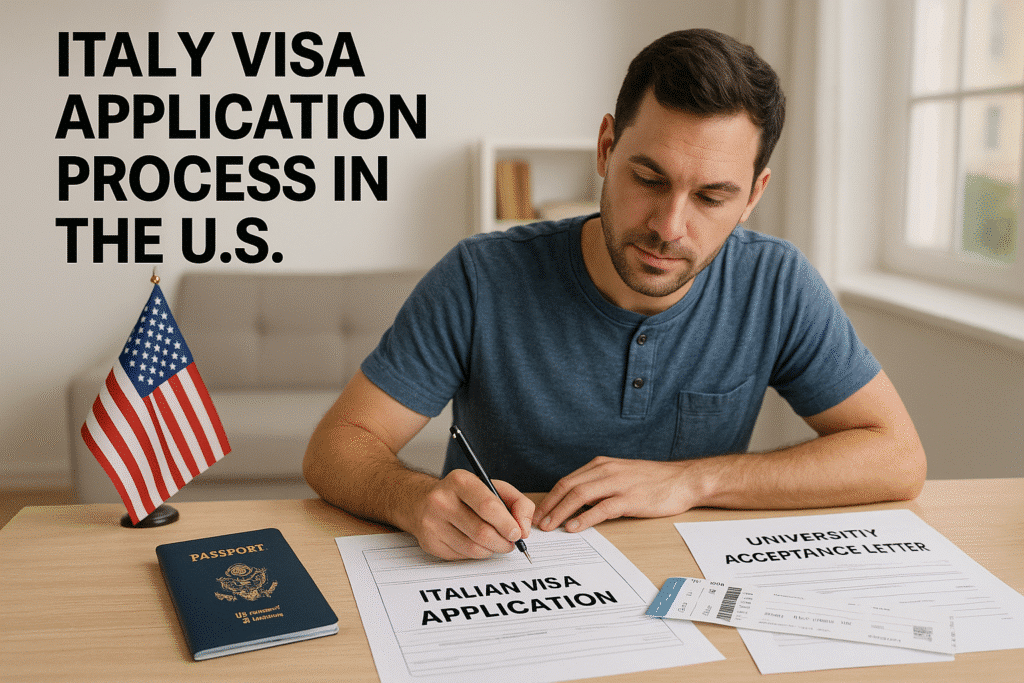
The application for the long-stay visa must be made at the Embassy or Consulate of Italy in the United States. Once in Italy, you cannot make an application for it.
The general process is as follows:
- Visit the nearest Embassy or Consulate of Italy to apply
- Fill out the visa application form (the online visa form is available from consulate websites)
- Prepare supporting Prepare the following supporting documents, including:, such as:
- Valid U.S. passport
- Passport-size photos
- Proof of financial means
- Evidence of accommodation in Italy
- letter of acceptance (for students) or job contract (for workers)
- Health insurance coverage
- Attend the visa interview and give biometrics (if required).
- Pay visa fee (type of visa varies).
- Wait time for processing: Generally takes a couple of weeks to months.
Residence Permit After Arrival
When you arrive in Italy with a long-stay visa, you must apply for a certificate of residence (Permesso di Soggiorno) within 8 days of arrival. This is provided by the immigration office in Italy, and you can live legally in the country with it.
I can recall the meticulous preparation I went through when applying for a Schengen visa for Iceland. A long-stay visa is even more complex, so you should start your application several months before you even travel.
ETIAS Authorization (Starting 2026)
What is ETIAS?
From 2025, US citizens will have to apply for an ETIAS (European Travel Information and Authorization System) before their short stay in Italy.
ETIAS is not a visa. Rather, it is a security pre-screening that the European Union is implementing to tighten its borders.
How ETIAS Works
The ETIAS authorization will function very much like the U.S. ESTA system. Before you board your flight to Italy, you will have to apply online and get approval.
Key Facts About ETIAS
- Mandatory from 2025: for all US citizens visiting Italy and other Schengen countries
- Cost: Around €7 (about $8).
- Validity: 3 years or until expiry of your passport (whichever happens first).
- Multiple entries: you can enter Italy and other Schengen countries several times during its validity
- Application form – online application with basic information such as passport number, trip itinerary, and background information.
- Runtime: Usually minutes, sometimes up to a few days if there is a need for additional checks.
Why ETIAS is Important
Even though visas are not required for short stay visits, ETIAS will be required. You will not be able to board your flight to Italy until you have been approved for ETIAS.
This has confused many travelers, but I find it to be a simple process. It’s simply an online application that you can fill out from home, whereas a full visa application at a consulate requires you to visit in person.
FAQs
Do I need a visa to travel to Italy?
American citizens are not required to obtain a visa for short-term visits of up to 90 days in Italy.
Who is exempt from a visa for Italy?
U.S., UK, Australia, Canada, and many other countries have visa-free entries to Italy for periods of up to 90 days.
Do I need to apply for an ETA to go to Italy?
Not officially ETA, but you will have to apply to get ETIAS authorization from 2026.
Do US citizens need ETIAS?
Yes, US citizens need to apply for the ETIAS authorization also for short-term stays in Italy and in the Schengen area starting from 2026.
Read Also: France Schengen Visa: Full Checklist + Pro Tips
Final Words
Are Americans required to have a visa in order to enter Italy? The answer to this question is based on the length of stay and the purpose of the stay. Provided that you spend less than 90 days in Italy, you can visit the country without a visa and with just your U.S. passport. But beginning in 2026, you, too, will be required to complete the ETIAS travel authorization before boarding a plane.
To spend more than 3 months in Italy to study, work, and/or live, you must obtain a National Visa (D visa) through the Italian Embassy or Consulate in the United States.