
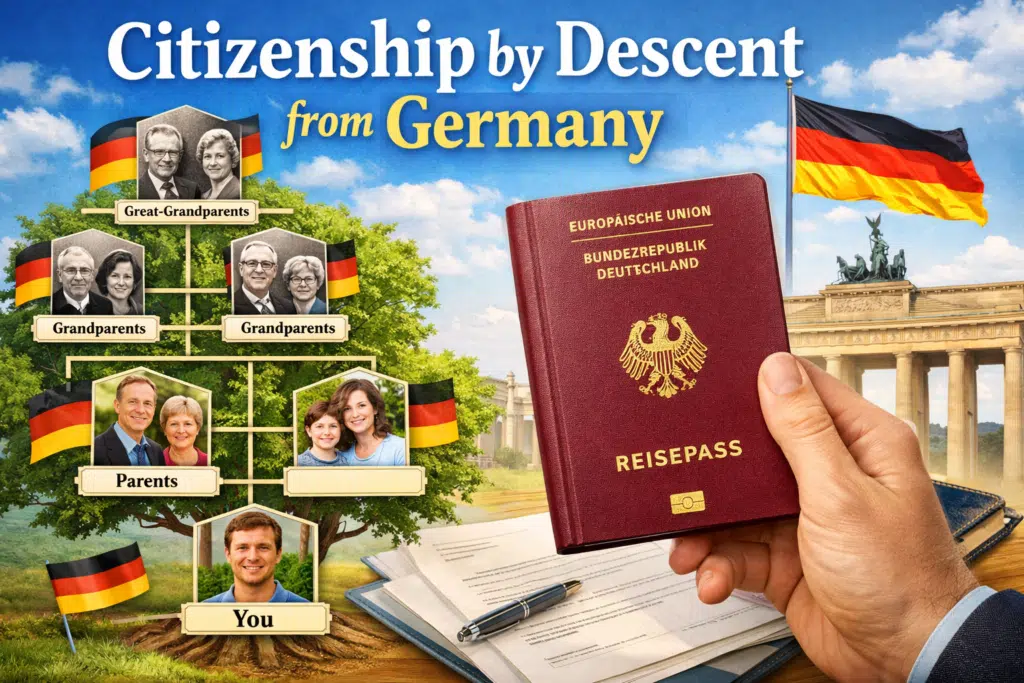
Are you a German-born, and do you have a wish to know whether you can now apply for a German passport? And in case one of your parents or grandparents (or even great-grandparents) was a German, then you are a German citizen by right of descent, too. The idea of jus sanguinis (right of blood) is applied in Germany, where citizenship is not acquired by location; rather, birth yields citizenship.
This is a comprehensive 2026 guide that I will provide explaining who can qualify, the impact of the recent legal changes on the qualifications, the documents that are required, and the step-by-step procedure on how to apply.
What Is German Citizenship by Descent?
German nationality by descent provides you with a chance to be considered a German citizen, provided that one of your ancestors was a citizen of Germany and passed the nationality on the legal side.
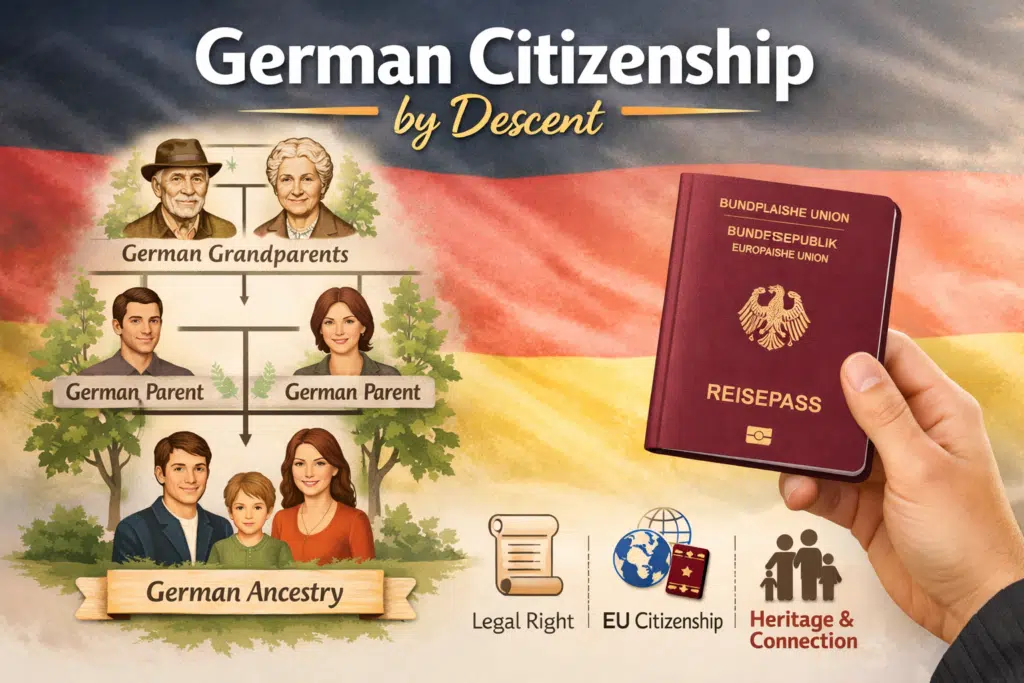
Who Qualifies for German Citizenship by Descent?
To be eligible, it requires several key considerations:
- The status of the nationality of your ancestor.
- The year your ancestor made the world.
- Citizenship was lost because of naturalisation.
- Pre-1975 laws of gender discrimination in the past.
- Whether your forebear escaped persecution in Germany by the Nazis.
- Whether the necessary birth registrations had been done.
Now I am going to discuss each of the pathways
German Citizenship Through a Parent
Automatic birthright Citizenship
You may automatically qualify if:
- One of your parents was a German when you were born.
- Before you were born, your parents never lost German citizenship.
When these conditions are fulfilled, then you must have been German at birth, although you may never have applied to be documented.
Rules Before and After 1975
This is very important.
- Before 1 January 1975, children born in wedlock had a right to German citizenship only in the case of German fathers.
- Since 1 January 1975, both German mothers and fathers have been able to transmit citizenship.
Even without being born later than 1975, you can still claim under modern correction laws, provided that your mother was a German (below, explained).
Children Born After 2000
If you were born after 1 January 2000 in another country and your German parent was born after that time, you may need to have registered your birth within one year.
There can be failure of eligibility due to failure to register; however, there are exceptions.

German Citizenship Through a Grandparent
It is here that a large number of individuals are qualified.
You may be eligible if:
- And your grandfather was a German national.
- Your father became a German citizen.
- One was not lost to citizenship at birth.
The Most Critical Issue: Loss of Citizenship
If your German ancestor himself/herself lost German citizenship through the voluntary naturalization in a foreign country before your parents were born, then your parents might not have been German citizens at all.
Historically, dual citizenship was not applicable in Germany. If your ancestor assimilated, e.g., Americanized or Canadianized, before passing citizenship to the next generation, that can disrupt the line.
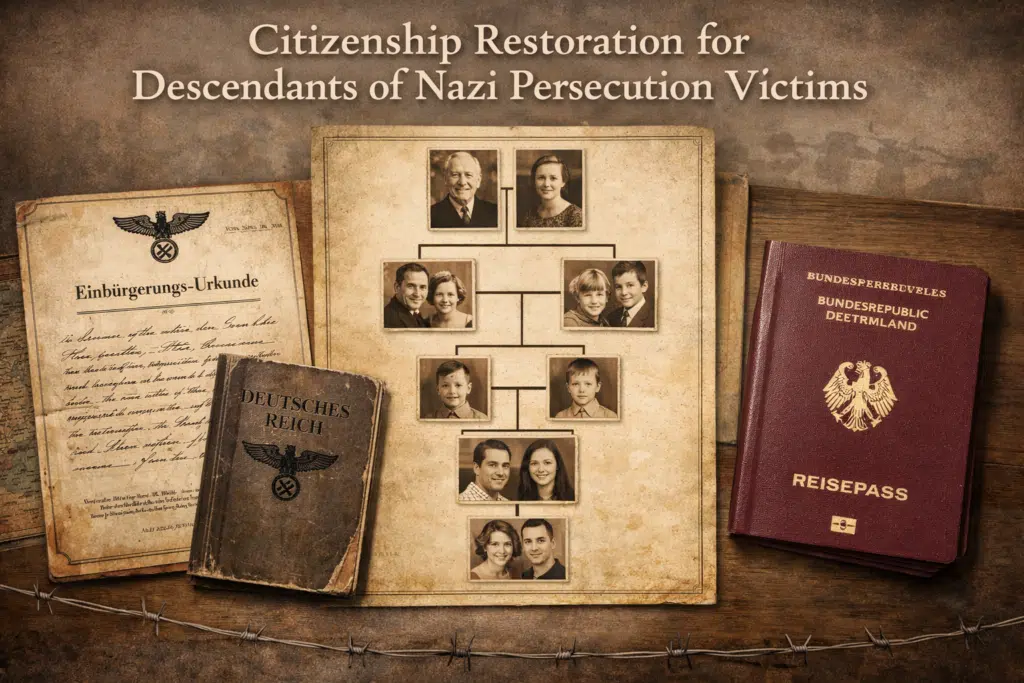
Restoration of Citizenship
The Basic Law of Germany under article 116(2) applies to persons who lost German citizenship between 1933 and 1945, and their descendants have the right to recapture German citizenship.
These reforms were extended in 2021 to correct historical wrongs.
This includes descendants of:
- Jewish families
- Political dissidents
- Roma and Sinti families
- People who are tortured because of their political or religious convictions.
The reforms are an indication of the constitutional arrangement, which was influenced by the theorising of the German Bundestag.
The cases of restoration are processed in a shorter time, and they do not typically need a language test or residence.
Cases of gender discrimination (Before 1975)
The German nationality law was discriminatory towards women until 1975.
If:
- Your German grandmother had a child before 1975
- The child was born in wedlock
- The father was not German
- The gender restrictions did not create any transmission of citizenship.
Numerous candidates who used to be rejected by the old law can now apply.
Children Born Abroad – Registration Requirements
In case your German parent both born outside Germany and after 1999, and you were also born outside Germany, you might have to register your birth with the German authorities within one year.
In case of the missed registration, eligibility can still be available under certain circumstances, but the process of documentation turns even more complicated.
Can German Citizenship Skip Generations?
Yes, but not in case the citizenship was lost.
Citizens’ German citizenship may be transferred across more than one generation, with the condition that:
- Every generation had legal right to be a citizen.
- None of the ancestors naturalized voluntarily and then passed citizenship.
- Obligatory registrations were done.
The more paperwork you will be required to give, depending on your age.
Does Germany Allow Dual Citizenship?
By the 2024 reforms, much broader dual citizenship is permitted in Germany.
In accordance with the new law of nationality:
- Your original citizenship can be retained frequently.
- On most occasions, automatic renunciation is not needed in Germany anymore.
This has transformed German citizenship by descent into something much more appealing.
Benefits of German Citizenship
One of the strongest legal statuses in the world is German citizenship.
European Union Freedom
Germany is a part of the European Union.
As a German citizen, you can:
- Live in France
- Work in Italy
- Study in Spain
- Setting up a business in the Netherlands.
- Retire in Sweden
You are free to move to over 27 EU members.
One of the Strongest Passports in the World
German passport is one of the most powerful in the entire world.
It can access over 190 countries visa-free or with a visa-on-arrival.
Access to Education
Public universities in Germany have few or no tuition fees, which German citizens may attend.
You get entry to one of the most powerful higher education systems in Europe.
Healthcare and Social Security
Germany is among the most advanced healthcare systems.
As a citizen, you benefit from:
- Universal health insurance
- Pension rights
- Social protection programs
Step-by-Step Application Process

Step 1: Determine Eligibility
You must carefully analyse:
- Your ancestor’s citizenship status
- Date of emigration
- Naturalization history
- Marriage dates
- Gender based rules of transmission.
This is the most crucial step.
Step 2: Gather Historical Documents
You may need to request records from:
- German civil registry offices (Standesamt)
- State archives
- Authorities on foreign naturalization.
Older cases might need archival research.
Step 3: Submit Your Application
The application procedure is done by the Federal Office of Administration (BVA) in Germany.
As an external applicant to Germany, this is where you ought to apply to the German embassy or consulate in your home state.
Step 4: Wait for Processing
Processing times vary:
- Normal cases of descent: 6, 24 months.
- Complex cases: 24 months and beyond.
- Cases of Nazi restoration: These are frequently prioritized.
Step 5: Issue of Citizenship Certificate.
With permission, you are issued a certificate of citizenship (Staatsangehörigkeitsausweis).
Then one can apply for a German passport.
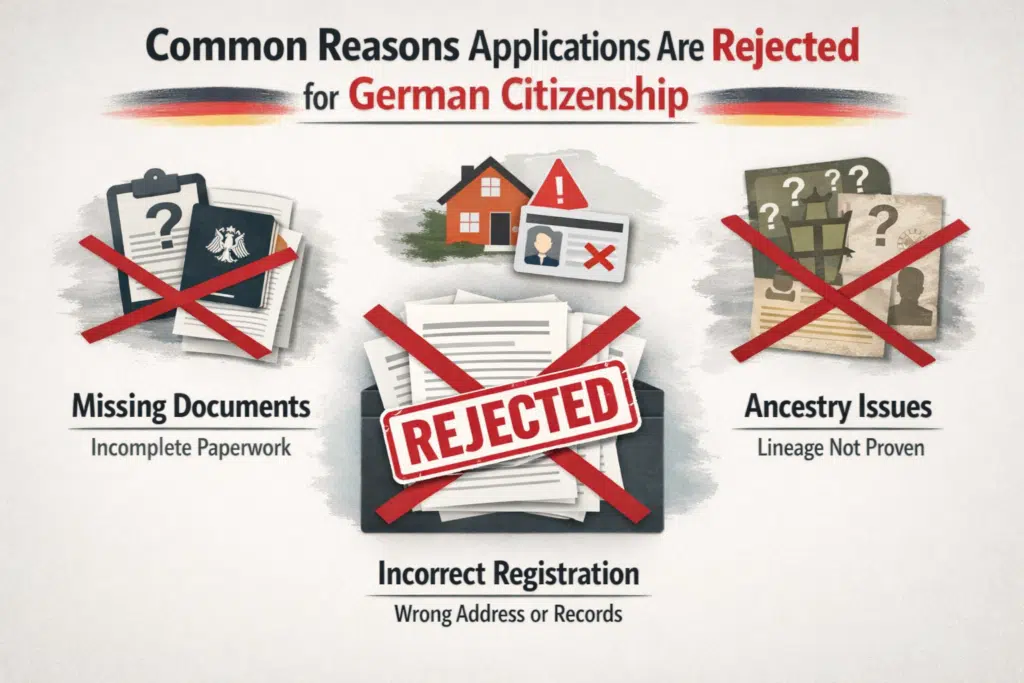
Common Reasons Applications Are Rejected
Some of the preventable errors that I can observe are:
- An ancestor naturalized before the birth of the child.
- Missing documentation
- The inability to register birth (younger generations).
- The wrong interpretation of the pre-1975 gender rules.
- Misinterpretation of pre-1975 gender rules
In complicated situations, professional legal examination can enhance the success rates quite substantially.
How Much Does It Cost?
Prices are different depending on the condition.
Typical Expenses
- Citizenship by descent application: Often free or a small administrative fee
- A separate government fee is required when applying for a passport.
- Document translations and certifications: Variable
- Legal assistance: Can be significant depending on complexity
Cases of restoration of descendants of Nazis are usually not administered at high administrative costs.
Processing Time in 2026
The loss of time has been caused by the increase in global demands.
In 2026, you can expect:
- Cases without complications: 6-18 months.
- Complex multi-generation cases: Up to 24 months
- Cases of Nazi restoration: In most cases, such cases are given priority.
Patience is essential.
Frequently Asked Question
Are you able to receive citizenship as a German descendant?
Yes, provided the loss of citizenship was not brought about earlier than that of the last generation, in case one of the ancestors was a citizen of Germany.
What is the length of time required to obtain German citizenship through birth?
The duration of documentation and case complexity is normally 624 months.
Who qualifies for citizenship by descent?
These children, grandchildren and in some instances, great-grandchildren of the victims of the Nazi regime, descendants of the victims of the post 1975 gender legislation, are all German nationals.
What generation will be issued with a German passport?
Possibly several generations, provided that citizenship was not lost and the registrations were made.
What are some of the new rules concerning German citizens by descent?
The new amendments (20212024) allow for more liberal dual citizenship, adequate gender discrimination prior to 1975, and easing of restitution on behalf of descendants of the persecuted.
Read Also: Safest Countries in Europe 2026 Ranked by Crime & Peace
Final Thoughts
One of the easiest access points to European citizenship is German citizenship by descent when one has German ancestry.
Recent reforms have:
- Expanded eligibility
- Self-corrected historical discrimination.
- Admitted to be a dual citizen
- Cases of simplified restorations.
If you have German roots, you may already qualify without knowing it.